
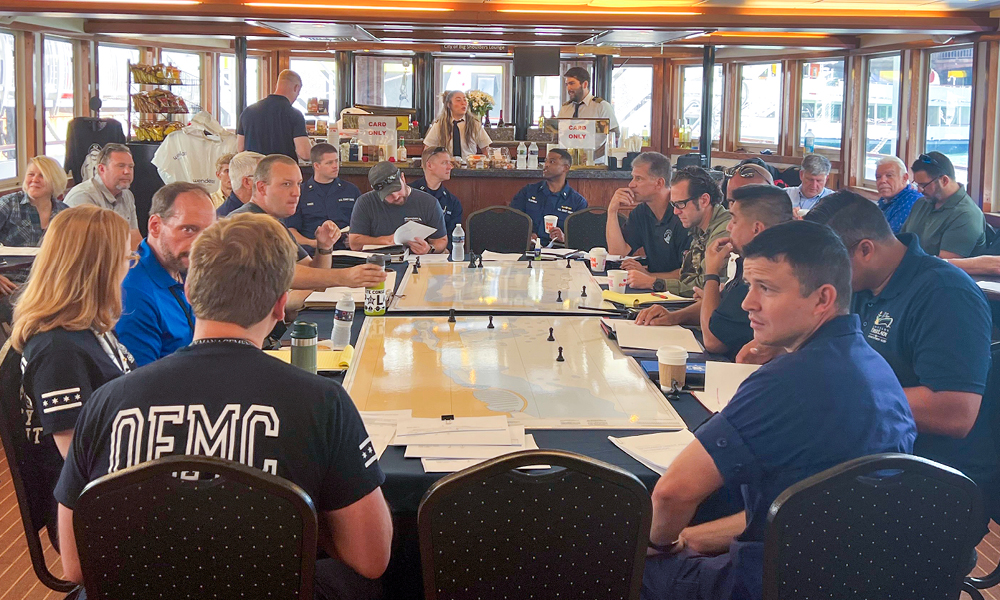
When I first got involved in the Chicago Harbor Safety Committee, I was serving as the director of marine operations at Wendella Sightseeing Boats and Chicago Water Taxi. In that role, it is my job to manage the overall risk of our operations, manage regulatory affairs, marine crew, and engineering. At the time our fledgling committee was just being formed because of recommendations from our recent Ports and Waterways Safety Assessment with the U.S. Coast Guard. This was also due to the increase in congestion as popularity of the waterways grew. In truth it was primarily at the urging and persistence of my employer Mike Borgstrom.
He is, in essence the co-founder and godfather of the Chicago Harbor Safety Committee.
Through the recent birth of our Harbor Safety Committee (HSC), I soon discovered there was an entire community of people from different waterways sectors who were focused on reducing the overall risk within our waterway. By engaging this group to discuss known issues and develop solutions, I found we could make a real difference in reducing navigational risk on the Chicago River. This meant I was successful at my job in decreasing risk, but it also helped the company’s bottom line. In my 38 years in this industry, I had never seen such an opportunity for collaboration between waterways users and agency partners.
So, what is an HSC, you may be asking? Simply put, an HSC is a forum for all of the different users of a shared waterway to come together to compare information and express concerns about what is happening within that waterway. What sets HSCs apart from other port or waterway-level committees is that these are typically industry or community led and not led by the federal government. They have a broad membership; anyone is welcome, and no one group or sector is any more important than the others. A shared waterway is everyone’s to use, and that mindset is key to encouraging committee members to work together to address local challenges. HSCs also have a broad focus, which includes topics related to the safety, efficiency, security, mobility, and environmental protection of the waterway. The diverse set of partners and broad suite of issues explored means that for any issue that arises, you generally have the right people in the room to assess blind spots and develop innovative paths forward. In my own HSC, I have seen this be successful in reducing risk and finding compromise time and again.
The diverse set of partners and broad suite of issues explored means that for any issue that arises, you generally have the right people in the room to assess blind spots and develop innovative paths forward.
Although HSCs do not have any inherent authority, they provide a sort of peer governance for the maritime community. Many HSCs develop best maritime practices or standards of care, which are designed to sensitize mariners to unique local conditions and operating practices within the region. These provisions are non-regulatory; they complement and supplement existing laws and regulations where appropriate. Often, they emerge as solutions to a known issue, and the HSCs that develop them typically refer to them as a form of “self-regulation.” Within HSCs these guidelines emerge as solutions to an observed issue and reflect a bottom-up approach; a mindset that self-regulation is best. It’s the committee getting together and deciding what it thinks is a good guideline for mariners operating in region. It’s not the Coast Guard or any state authority telling them what to do. It’s the committee with true local knowledge deciding what they are going to ask each other to do. They can be tailored exactly for a specific situation in the port and are of tremendous value to the HSCs that choose to develop them.
At my HSC in recent years, we have focused on making gains in several areas. I’ll highlight two here: deconflicting waterway use and running port-wide exercises to prepare for potential emergency scenarios.
Use Deconfliction
At the Chicago HSC, we believe that transparency and common ground provide the foundation for addressing user conflicts in the waterway. More often than not, users in conflict simply do not understand how the other operates. It’s all about sharing perspectives. Once we can shine a light on how each operates and the challenges one group might be creating for another, we have found great success in identifying solutions. One multi-faceted example is how we have worked to engage recreational boaters, specifically within the human-powered sector (rowers, kayakers, paddleboarders, etc.).
One of the first conflicts we observed and worked to address was between the human-powered sector and the commercial vessels on the river, and one of the first strategies we tried was to get the stakeholders in each other’s shoes. That is, we worked with the local rowing community and put its members in the pilot house on passenger vessels, barges and tugs so they could understand what the captains see and how limited visibility can be; these engagements also allowed the crews to talk about the maneuverability and constraints of their vessels. We also got those captains to go to the rowers and sit in kayak so they could understand the rower and paddlers perspective as well. That effort to share perspectives and deepen awareness of operational capabilities had a profound impact in helping those communities understand what to expect and how to behave around one another in the waterway.
The Chicago River is home to a large number of well, and not-so-well, organized businesses that run tour-guided kayak events. We also have a very large unguided, self-operated community of independent kayakers. The contrast between the two is great. The tour-guided folks get some training in safety procedures. The city is investing in the river walk and river access, so there will be more personal launch points. The second group, the unguided kayakers, we are very concerned with; they have little training and experience with the informal lanes and protocols. Our HSC worked to get together the human powered craft community and the passenger vessel community to share concerns and perspectives. In the beginning of this surge of paddlers, our passenger vessel community wasn’t tracking that there were two different groups of kayakers. The HSC helped us to recognize the two different communities, and what they can expect from their knowledge base. Thus, we could identify potentially untrained paddlers, which signaled to us the need to be more prepared for the unexpected.
Emergency Scenarios
At the Chicago HSC, we recognize we occupy a unique niche within the community that allows us to contribute to port preparedness and resilience for recovery from a major incident. To that end, we have led or participated in several local field training exercises to bring our broad-based stakeholder networks together to address emergency scenarios. This started in 2022 with our first exercise focused on an active shooter scenario. Since then, we’ve done four additional exercises on active shooter, mass rescue and SPV marine firefighting scenarios. Planning for and executing these exercises has significantly contributed to increased communication, understanding, and industry/agency partnership within the maritime community. There is no doubt we are all better prepared as a result of this work.
Planning for and executing these exercises has significantly contributed to increased communication, understanding, and industry/agency partnership within the maritime community.
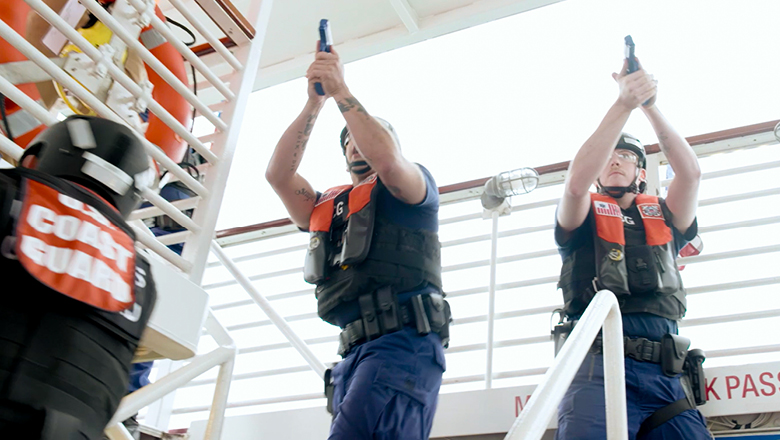
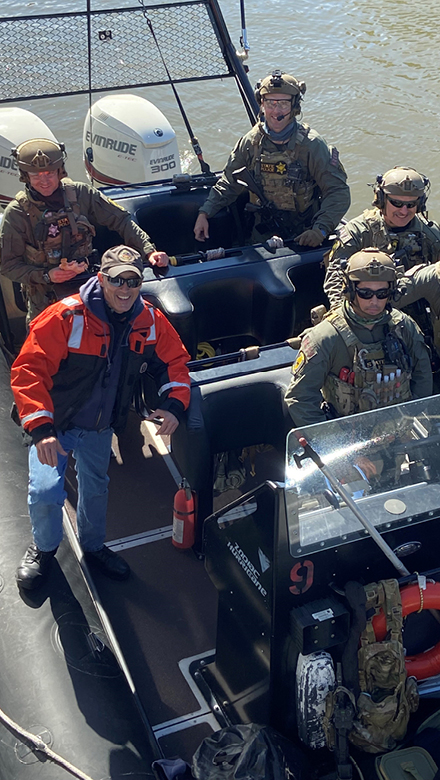
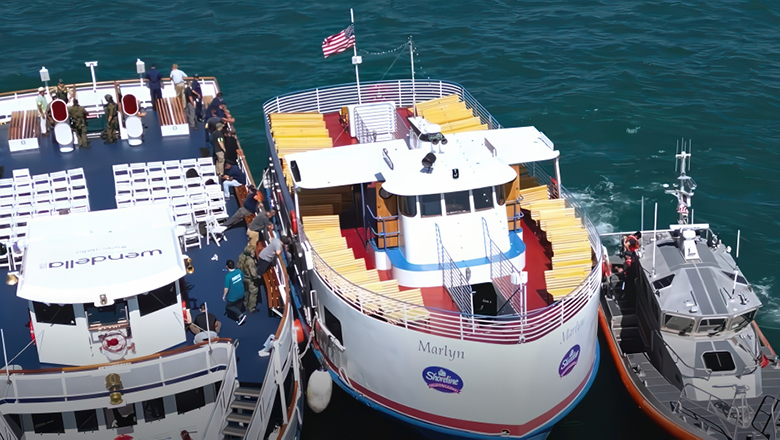
You may be wondering how the HSC ended up leading such an effort, as opposed to a government entity or the Area Maritime Security Committee (AMSC). It’s the members of the HSC that have relationships, access to the assets and facilities, and giving first responders an opportunity to become familiar with those things before an incident is critical. Because of the breadth of focus and the diversity of partnerships that exist within the HSC, we were able to connect dots and bring people together in a way that had not been feasible previously. Our focus on safety and addressing risk within the waterway meant that once we saw issues and opportunities in this space, we felt it was our mission to take on the challenge. HSCs are very adept at breaking down or bridging individual agency or company silos of information—we can be the connective tissue. This is a challenge that cannot be overstated and one that take continuous nurture.
We do this work because it is the right thing to do, but we have also found that participation in the Chicago HSC is good for business. For Wendella specifically, engagement in the Chicago HSC has tangibly contributed to our bottom line through reduced incidents and to the morale of our employees who see we are out there doing something about the congestion. By partnering with our community to reduce risks within our waterway, we have also reduced the risk to our operations.
We do this work because it is the right thing to do, but we have also found that participation in the Chicago HSC is good for business.
PVA members have unique skill sets and are pre-wired to actively contribute and participate in Harbor Safety Committees. We already have an excellent relationship with our Coast Guard counterparts, and we understand the regulatory structure. We can be the best asset and guide for our MSU waterways chiefs who may have little to no local knowledge. I have found that in serving on our HSC that a good part of my time is translating the regulatory language we speak in order help other unregulated sectors understand the why and the how of port management. The remainder of my time is spent building bridges between the solos of our agency partners. As PVA members, we value partnership and see how important that is to elevating safety for all.
Other Harbor Safety Committees throughout the nation are making progress in addressing risk within their ports and waterways. There are currently around 50 HSCs across the nation. The oldest is in the Port of New York/New Jersey, which purports to have formed in 1914. The youngest was formed only a few months ago; and seven have formed in the last two years. This network is supported by the HSC National Steering Team, which serves as a guiding body HSCs can turn to when they need support. The mission of the HSC National Steering Team is to provide information, guidance, and inspiration to support the establishment, development, and sustained excellence of HSCs nationwide.
The HSC National Steering Team has helped establish five new HSCs in recent years (with several more in development) and is responsible for organizing the biennial National Harbor Safety Conference. The most recent conference was hosted in March 2026, by the Puget Sound Harbor Safety Committee in Seattle, Wash. A key theme that emerged from the conference was the desire to improve information sharing across ports, and this will be an area of focus for the HSC National Steering Team moving forward. If you would like more information, want to identity your local HSC, or are interested in forming one in your community, reach out to noel.t.jones@uscg.mil to engage the National Steering Team. If you would like to talk more about how PVA members can make a huge impact in harbor safety, I can be reached at mcm@wendellaboats.com.
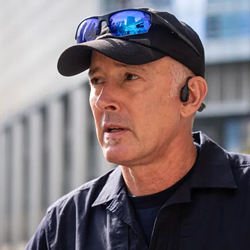
Capt. Mike McElroy // Director of Marine Operations and Regulatory Affairs, Wendella Sightseeing Boats and Chicago Water Taxi
Capt. Mike McElroy has served the passenger vessel industry for 38 years. In addition to his role as the director of marine operations and regulatory affairs, he is the designated person for Wendella’s flagship SMS. He satisfies his passion for safety, security, hospitality, and the environment through engagement as the co-chair of his Area Maritime Security Committee, as president of the Chicago Harbor Safety Committee, and as the co-chair of the HSC National Steering Team. He is the recipient of the U.S. Coast Guard meritorious public service award three times and the PVA Roger Murphy Safety Award for contributions to marine safety through development of training programs that target an increase in safety culture.