
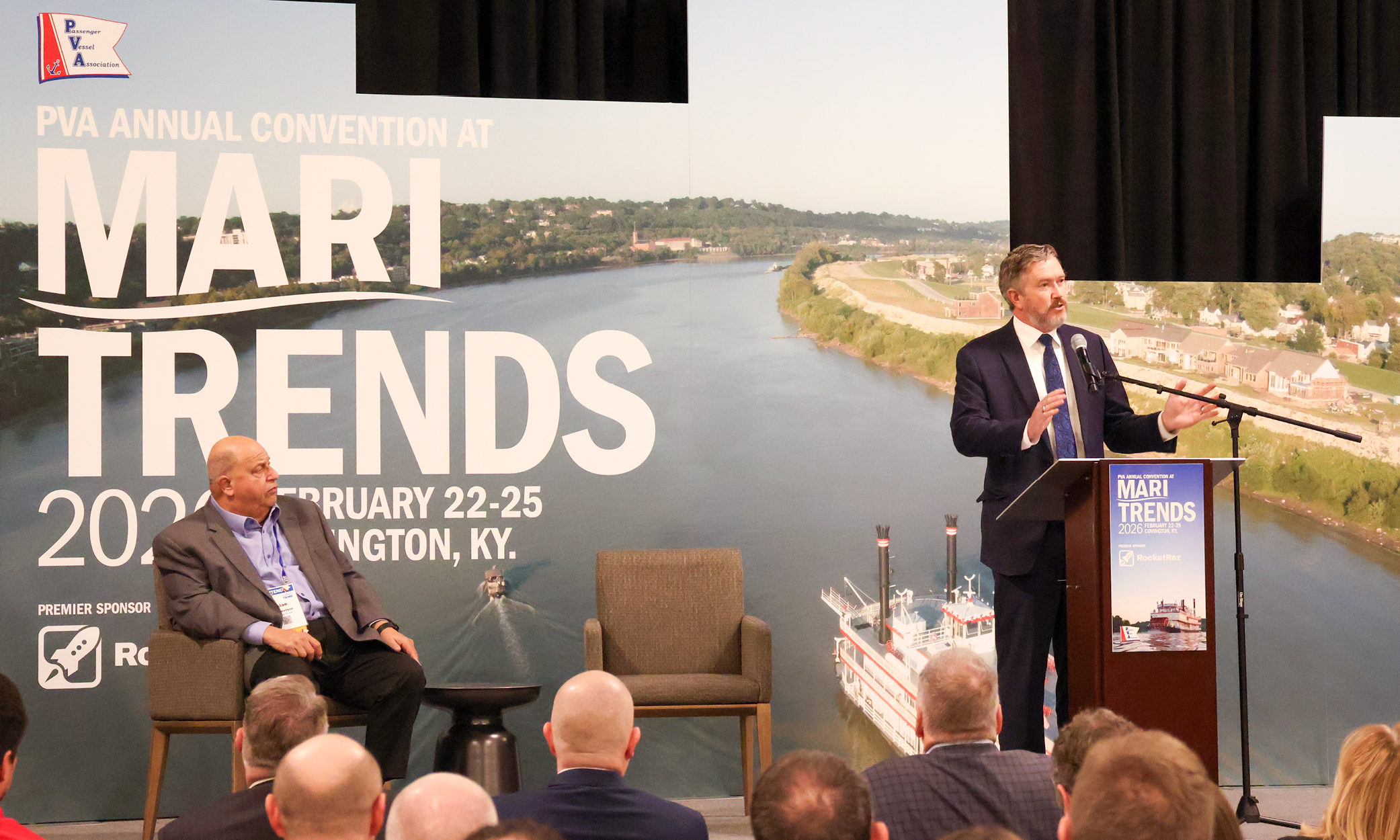
Known for his independent thinking, analytical rigor, and commitment to principle, Kentucky Congressman Thomas Massie opened the PVA Annual Convention at MariTrends 2026 as the keynote speaker. He touched on the importance of the Jones Act, discussed a path forward to resolving the ongoing government shutdown, and shared his passion for serving the people.
Now in his seventh congressional term in Washington, D.C., Massie started his political career in local government. Today, he represents the Kentucky 4th Congressional District and serves on the House Committee on Transportation & Infrastructure and the House Judiciary Committee. Handling maritime transportation, infrastructure, regulatory policy, and economic growth, the Committee on Transportation & Infrastructure is of key significance to the passenger vessel industry. Prior to his roles in government, Massie earned his bachelor’s degree in electrical engineering and a master’s degree in mechanical engineering from MIT.
In his straightforward style, Massie started his keynote by addressing the top concern on people’s minds, the continuing shutdown of the Department of Homeland Security. Acknowledging that the struggle has fallen along party lines, he pointed out some requests on the table that he saw as reasonable, common sense and in some cases simply constitutional—all possibly guiding the way towards a resolution.
Since his start in Congress, he has been part of the Committee on Transportation & Infrastructure and explained that he sees it as a place that the federal government should be involved. To support his position, he referred to Adam Smith and to the Supreme Court case of Gibbons v Ogden. He explained that Smith, who is often called the father of modern economics and was read by the nation’s founding fathers, saw three roles of government. Those were to provide for the common defense, to institute a system of justice, and to do public works and infrastructure. This was influential for Massie in his decision to join both the Committee on Transportation & Infrastructure and the House Judiciary Committee, addressing two of Smith’s three roles.
The court case of Gibbons v Ogden has also been impactful for Massie. The case was decided in 1824 and held that the Commerce Clause of the U.S. Constitution that grants the power to regulate interstate commerce includes the power to regulate navigation. States had been handing out patents for steamboats, effectively creating monopolies of the vessels and interrupting interstate commerce. The court ruling changed that, and Massie noted the ripple effect. The same year, the General Survey Act passed which allocated money for waterways and land routes to connect states and expand trade and allowed the president to employ military and civil engineers for the purpose. This has been seen as marking the true beginning of the U.S. Army Corps of Engineers’ Civil Works Program. For Massie, this is an example of the importance of government involvement in transportation. He noted, “I’m a constitutionalist. People say, you don’t want any government at all. I do want government. I just want it to work, and I want it to be inside of its proper role.”
His engineering background makes transportation of keen interest to him. While at MIT, he had the opportunity to hear John Sununu, former governor of New Hampshire and White House chief of staff to President George H.W. Bush, speak. Sununu noted that he saw Congress as needing fewer lawyers and more engineers, explaining that lawyers are trained to take a position. They will look for facts to support their position and try to ignore facts that don’t. Engineers, however, are trained to first collect facts and then come up with a position. Sununu pointed out that one of these methods was good for solving problems while the other was good for starting fights. This appealed to the engineer in Massie. “That stuck with me,” he said. “That’s another reason that I like being on the transportation committee.” Looking to first learn the facts and gather information, he seeks to bring this commonsense approach to his work on the committee.
Massie touched on the ranking of committess as Class A, Class B, or Class C. While transportation is ranked as a B committee, Massie stated his case that it should be ranked as an A. In his congressional district alone, he said there are three locks and dams and 280 miles of the Ohio river. He noted Kentucky is home to the Cincinnati & Northern Kentucky Airport, as well as the North American headquarters for DHL, Amazon, and UPS.
With the Ohio River running through Massie’s district, he has a personal interest in Water Resources Development Act (WRDA) which is in development with the goal of passing this year. “We’ll get that done,” he promised. Massie has taken particular interest in a cost share issue along the Ohio River. He discussed the portion of costs being shouldered by boat operators, specifically mentioning barges, even though the locks and dams play a larger role in the state. They are used for recreational purposes, to manage municipal water supplies, and for flood control. It is his hope that the associated costs are distributed in such a way to reflect the broad use of the locks and dams and not placed on one industry.
Massie described the Jones Act as “an issue of national security and just common sense.”
Beyond the concerns of local inland waterways and vessel operators that use them, Massie’s interest in marine transportation extends to the Jones Act. Massie joked that while some may say his support of the Jones Act is one of the most un-Libertarian things about him, he described the act as “an issue of national security and just common sense.” A sentiment echoed by attendees.
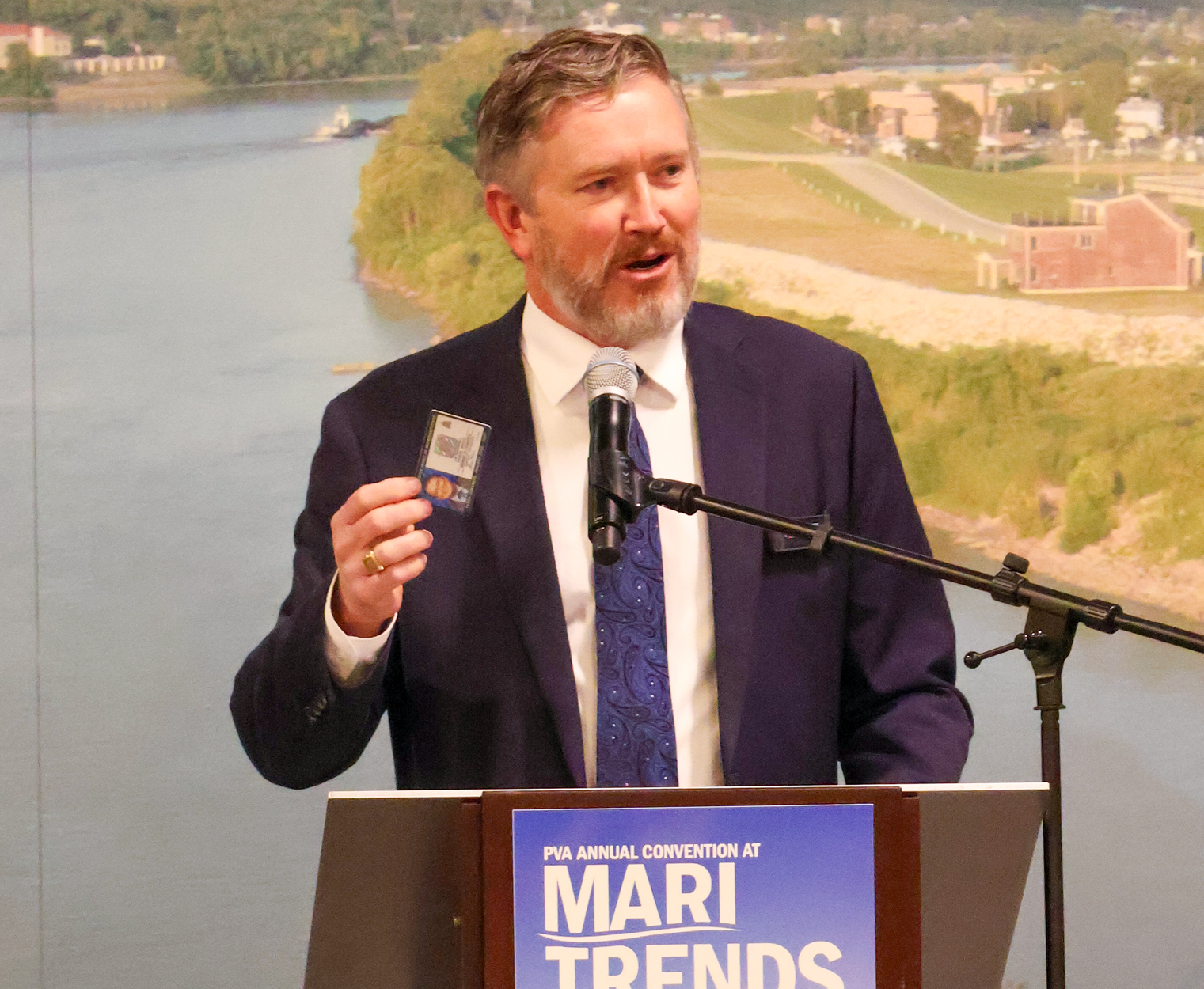
With so many important issues being debated and voted on in Congress, Massie offered a peek behind the curtain of how voting takes place. Tucked into his wallet alongside his driver’s license and credit cards, is his Congressional voting card. As he held it up, he noted that though it has his name and photo on it, it doesn’t belong to him but instead belongs to the people of Kentucky. About 10 times a day, he said, members vote by placing their card in a machine and choosing between a green buttoned labeled yay and a red button labeled nay. Massie suggested they should be labeled spin or don’t spin. “I get in trouble for pressing the don’t spin button all the time,” Massie said. “Some people call me Mr. No, but I do vote yes sometimes.”
He told of once accidentally handing his voting card to a waitress to pay. When he asked why it didn’t go through, he joked that she told him that “it’s already got $38 trillion on it.” Conversely, he was concerned when he mistakenly put one of his credit cards in the voting machine. Realizing his error, he thought, “What would happen if I hit yay on my MasterCard? Would they charge me one over 435 of the expense, or would I get the whole bill that day?”
Massie began his political career at the local level in his home state of Kentucky. He grew up in a small river town not far from Covington where MariTrends was held. The town was the largest town in the whole county with a population of 1,900 and was the county seat. He carried that small town sensibility with him to Massachusetts when he left for college. On his first day there, as he went through a crosswalk a car honked at him. He recalled thinking, “Oh my gosh, I’ve already run into somebody that knows me.” He turned around to see who it was and to wave. Life there was a bit of a culture shock, though he got used to it.
After a decade or two away, he moved back to Kentucky and started a business. Eventually, he became involved in local politics as a county judge executive, which he described as an interesting experience. It was a stark contrast to what he’s found after moving to Congress. Massie stated that it’s been frustrating and acknowledged the limitations of power he’s discovered. He shared a story to illustrate his point.
A woman called the congressman in office before him and asked what he was going to do about her trash pickup, that she had put the bin at the end of her driveway, but the truck hadn’t come that week. She was annoyed and pushed the congressman to tell her what he was going to do about it. In Massie’s telling, the congressman responded that he was on the infrastructure committee but that they don’t deal with trash pickup. When the Congressman suggested she call her commissioner instead, the woman replied, “I wasn’t going to start that high up.”
With that disclaimer and a shared laugh, Massie opened the Q&A session to hear directly from PVA members. The first question addressed the shift of U.S. Coast Guard priorities away from safety and security on the waterways, asking what Congress and the House Committee on Transportation & Infrastructure can do to help.
Massie agreed that safety should be one of the top three priorities for the Coast Guard and said he’d make the case for such to the committee chairman. Regarding funding, he drew an analogy to a room of hostages. The goal is often one giant bill, with parties holding back the top issues, like hostages, as pressure to get their own needs and wants met. Massie proposed that instead of one bill, it should be broken down into three or four bills to act on bipartisan issues, effectively releasing some of the hostages. “
There’s not generally any desire in Washington, D.C., not to have the Coast Guard funded,” he said. “It’s a bipartisan thing, and it fits in, I think, the transportation framework, and it should be passed.” While he stated they can try to put a bill on the floor that deals only with the Coast Guard, he was candid in recognition that it was unlikely to happen. Referring to his analogy, he noted, “I don’t think the leadership of either party wants to do that because they want it to be a big enough fight that they can get something for their hostage. So, they’re going to take your hostage, too.”
For the republic to work, it’s important “not to have the executive branch making law or imposing taxes, that power is vested with Congress.”
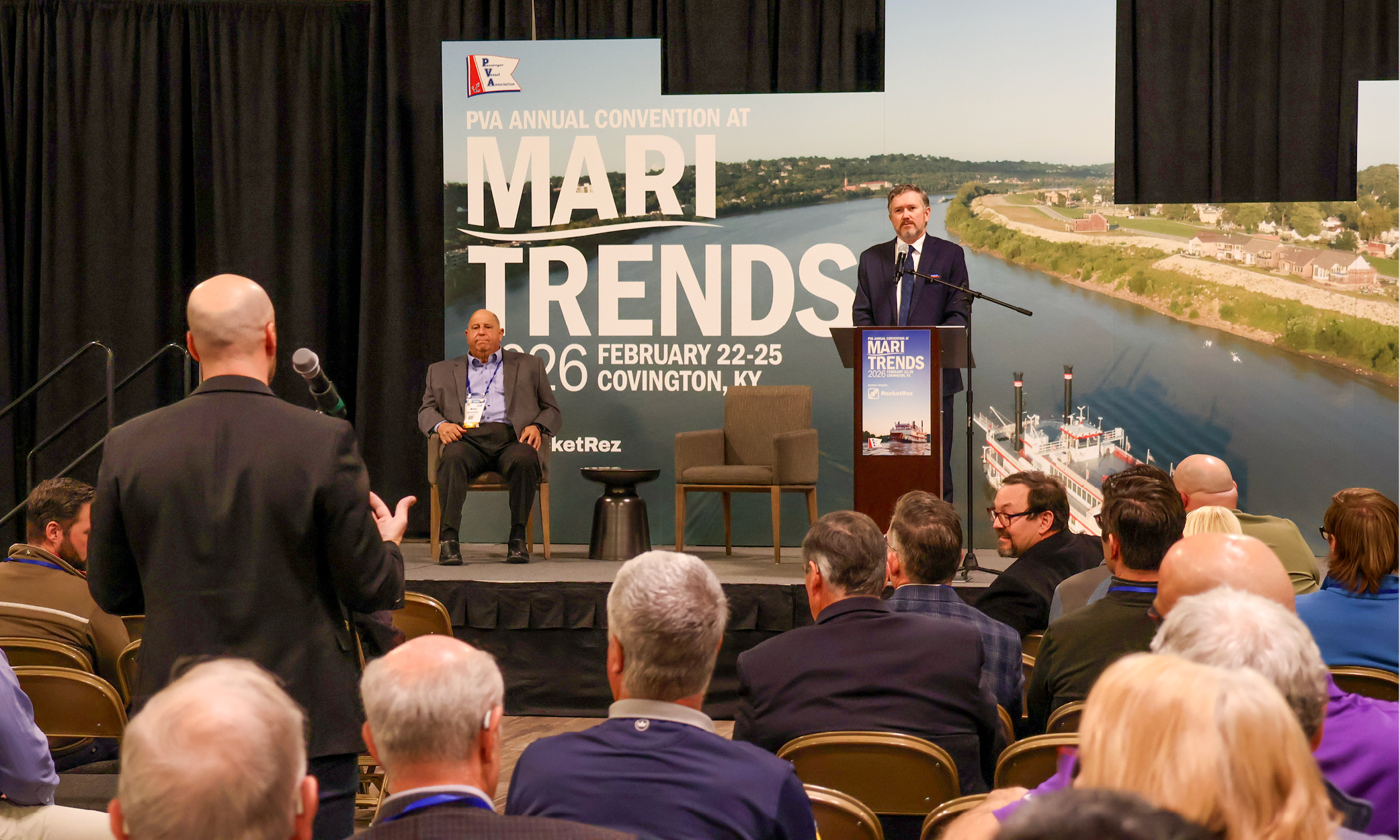
The SHIPS Act was on the mind of another attendee and Massie offered to take another look at it. The goals of the bill as described by the audience member were all ones that Massie shared. He offered the honest opinion that things government touches often don’t go as expected, referencing the last infrastructure bill. With that in mind, he recommended members also seek channels, such as associations, where they can personally take some direct action.
The final question of the session addressed tariffs to which Massie expressed his concern that the tariffs aren’t doing what they were intended to do. He described the tariffs that were put in place as an added tax, increasing the price of “literally everything.” He agreed with a recent comment by Supreme Court Justice Gorsuch stating that major decisions like tariffs “are funneled through the legislative process for a reason.” Massie noted that such decisions should not be made by administrative rule, stating that for the republic to work, it’s important “not to have the executive branch making law or imposing taxes, that power is vested with Congress.”