
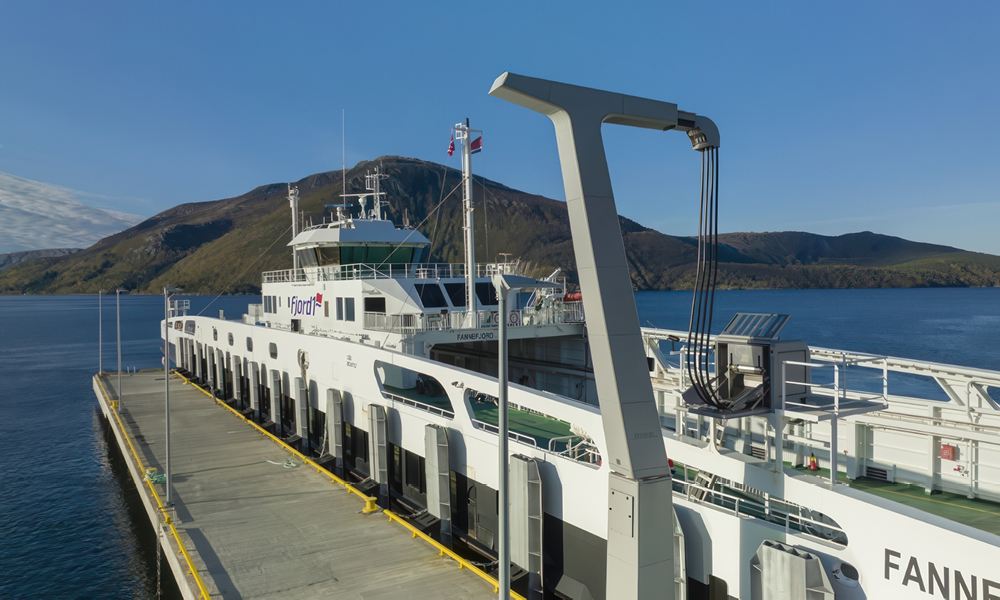
As passenger vessels shift toward emission free operations and all-electric propulsion, shoreside infrastructure becomes a vital link in the energy supply chain that must not be underestimated. The process of securing sufficient power available at the docks for a reasonable rate is complicated. It involves many stakeholders, and the entire process is indeed time consuming.
For land-based utility companies, serving intermittent and high-power consumers is a challenge. It has an impact on the entire grid capacity as this less predictable and intermittent consumer must be calculated into the overall system. Ports and piers are often located at the outskirts of the grid, making capacity upgrades even more costly to meet peak demand. Despite the challenges, the future of electric vessels should be welcomed as a future source of increased revenue for local utility companies.
Despite the challenges, the future of electric vessels should be welcomed as a future source of increased revenue for local utility companies.
Shore power is already available at many U.S. ports. The main purpose is to enable vessels to shut down engines while at dock. For large vessels like container ships and cruise ships, this provides benefits for both shipowners and ports. Shipowners can carry out necessary operations while also performing inspection and maintenance work prior to next trip. However, once vessels leave the dock, they rely entirely on their combustion engines again. Shore power and shore charge share similarities, but they serve different purposes.
The Shift From AC To DC Onboard A Vessel
When discussing all-electric vessels, we typically refer to battery-operated ships, such as ferries, passenger boats, harbor cruise vessels, or similar crafts operating within cities or ports. These vessels are built around onboard energy storage systems (ESS). A DC link in the range of 700-1000 VDC is commonly used for power distribution. To charge such a vessel, the shore side grid power must be converted from AC to DC. This raises a fundamental, but technical question: Where should the AC/DC transformation occur, at shore side or on board the vessels?
AC as a Charging Source
AC shore power can be used for charging. In that case, the vessels will have complete systems onboard that converts the AC power to DC and internally control the entire charging process onboard the vessel. In effect, the vessel carries its own charging station onboard. However, this increases weight, requires more space and will most likely raise vessel construction costs.
For many vessels, especially weight-sensitive and high-speed passenger vessels, this is not acceptable. Harbor crafts, tugs, and smaller vessels might carry the weight but often lack sufficient space for all the equipment. Carrying heavy equipment onboard a vessel all the time, that is only being used during charging at a dock, contradicts the logics as well.
DC as Charging Source
Electrical cars have used DC charging since the birth of EVs. Regulation and standardization have made it possible to charge most vehicles at any station. CCS charging, commonly used for EVs, typically limits themselves to 300-400 kW. CCS is also being introduced for pleasure boats. However, commercial vessels require charging capacities of 1 MW and higher.
Heavy duty trucks, port equipment, and the mining industry are examples of large consumers requiring charge capacity equal to mega charging systems (MCS). CharIN, a global, non-profit industry association focused on standardizing electric-vehicle charging has developed common standards for charging in megawatt scale. CharIN has created a Marine Task Force to extend proven MCS concepts into maritime use cases while coordinating with class societies and existing IEC/ISO marine standards. The MCS standard has been implemented in several marine projects recently.
Both AC and DC are reasonable alternatives for vessel charging. However, when looking beyond the technology itself, the commercial aspect will play a decisive role as well. The majority of ports and cities worldwide have committed to reducing or eliminating emissions caused by their local activities. The revenue will shift from bunkering fossil fuel to e-bunkering. But there is a chicken-and-egg situation in the transition as well. Ships cannot be required to operate emission-free unless ports and cities can provide alternative sources of energy at a reasonable cost.
Ships cannot be required to operate emission-free unless ports and cities can provide alternative sources of energy at a reasonable cost.
Shoreside Participation in Charging Infrastructures
The potential of standardized DC charging at megawatt scale offers broader benefits. Shoreside heavy-duty consumers such as rubber tire gantry cranes (RTG), trucks, buses, and other machineries can share the same MCS charging infrastructure as harbor and city crafts. Another potential benefit is to locate grid stabilizing energy storage systems inside the ports themselves. Utility companies in the U.S. alone are investing tens of billions in ESS for grid stabilization and optimization of renewable energy sources. If some of these investments are allocated at ports, multiple benefits can be achieved. The ESS can be available for grid support upstream on a general basis, combined with providing high power downstream to its own consumers without peak demands when vessels charge. A potential third benefit is to utilize the ESS as an emergency power source for dedicated consumers within the vicinity.
As a technologist and a true believer in electrification, I see mainly advantages and opportunities with the new technologies. It’s a matter of collaboration and our ability to think ahead when planning future transportation. But we must remember that electrification of marine transportation connects shore-side energy policy with ship operations. Power availability has proven to be the weak link in the maritime electrification process worldwide. Ports, harbors, and cities can turn the table by becoming more active in grid stabilizing and renewable energy generation, with reserved capacities to serve its own customers and fleet as needed.
Ports, harbors, and cities can turn the table by becoming more active in grid stabilizing and renewable energy generation, with reserved capacities to serve its own customers and fleet as needed.
Technically, It’s Feasible…
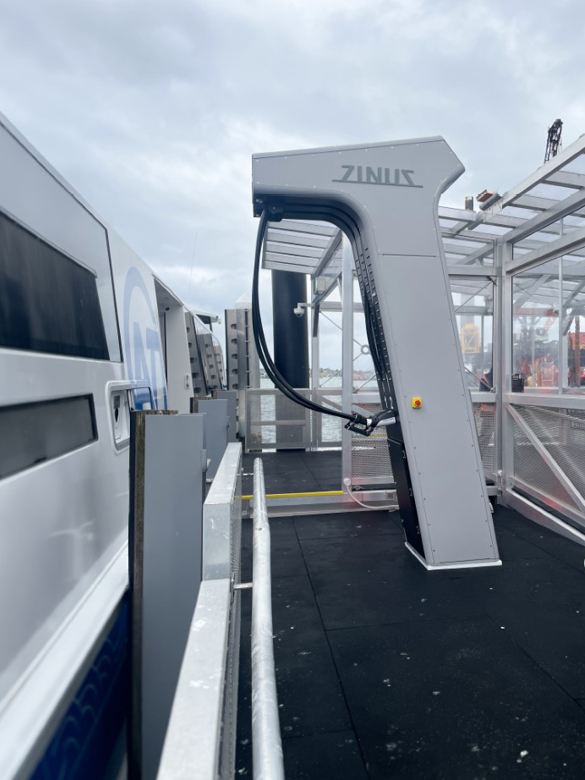
Zinus is a company that makes shore power and shore charging solutions for marine applications. Our focus is to ensure safe, reliable, and secure connections between shoreside and vessels regardless of purpose, chosen technology or source of energy. The systems follow international standards to ensure connectivity for all ships, including visiting vessels.
Depending on the frequency of use, the systems can be manual, automatic or even fully autonomous. With more than one million connections recorded, Zinus has become a key player in connecting shore to ships. The photos included in this article are examples of charging solutions available.

Sveinung Odegard serves as president of Zinus Power LLC, the North American subsidiary of Zinus AS, headquartered in Seattle, Wash. A longtime U.S. resident with over three decades of maritime industry experience, he has extensive expertise in shore power systems, port electrification, and sustainable marine operations. Since establishing Zinus Power LLC in 2025, Odegard has led the company’s expansion across the U.S. and Canada, supporting ports and vessel operators in meeting increasingly strict environmental and efficiency requirements.