

From our windswept home of the Åland Islands, we at Carus—one of the global leaders in digital customer solutions for the ferry industry—are setting a new course for passenger experience. The industry stands at a pivotal moment, poised to move beyond functional but fragmented digital tools toward truly intelligent, autonomous customer service. This evolution is being driven by the pragmatic application of a cutting-edge concept: agentic artificial intelligence (AI), which we integrate in our existing customer solution, Carus Engage.
Without a doubt, AI marks a new era in digital consumption. That’s why it is not only important to consider the potential of AI in the development of new tools. It is also important to understand why it’s being utilized. Therefore, we will explain where our approach to agentic AI for booking systems comes from, why it ties into the needs of the industry´s customers, how it can fundamentally transform the ferry customer journey, and, not the least what this could mean for operators´ sales, turnover, and income.
The Current State of Digital Booking
Limits and Potential
Booking and reservation systems in the ferry industry today are by and large, highly functional engines for transactional efficiency. A passenger can efficiently select a route, a journey, and buy a ticket. The underlying IT structures are excellent at guiding a customer through this set of logical, pre-defined steps. These systems have digitized the core commerce process, replacing paper tickets and manual calculations with digital precision in pricing and inventory.
However, the moment a customer’s journey deviates from the script, the system’s limits become apparent. A question about a specific pet policy, a need to modify a booking mid-voyage, or an unforeseen disruption demanding proactive information—these are the friction points. When these complexities arise, the systems often lack the flexibility and contextual awareness to handle the situation dynamically. The passenger is then frequently routed to a fragmented system: a general office, or no reply-email address, an online FAQ that doesn’t quite answer the question, or a customer service line where they must wait on hold and repeat their entire story to an agent, maybe several times until they reach the right person. Digital customer support has seen improvement, of course. Traditional, rule-based chatbots offer 24/7 availability and are basically only limited by the programmer’s imagination—meaning they are inherently rigid, only working when the customer’s question exactly matches a pre-fed script. Furthermore, the first wave of large language model (LLM)-powered chatbots demonstrated the potential for natural conversation but often fell short on reliability. These systems are prone to drift or hallucinate, generating plausible sounding but factually unreliable responses. The infamous case of a major airline being held liable for a chatbot’s incorrect discount advice underscores the critical need for an AI system that is both intelligent and—through targeted control and limitation—accountable.
What the industry needs is a new tier of service—one that honors the investment already made in robust reservation systems while unlocking the next level of personalization, proactivity, and efficiency.
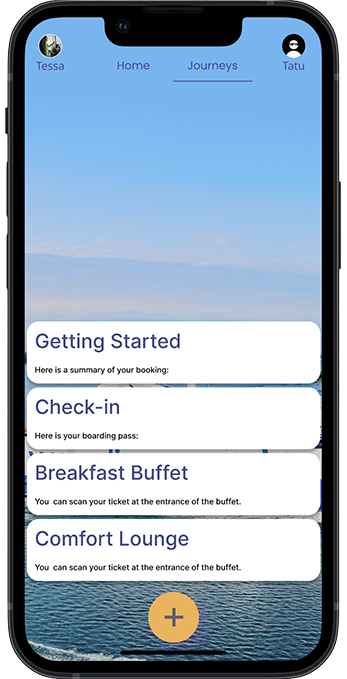
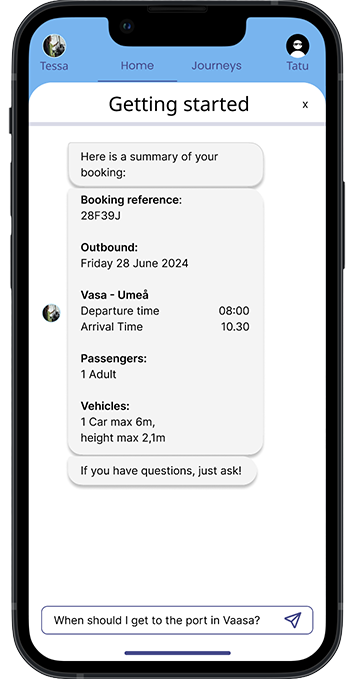
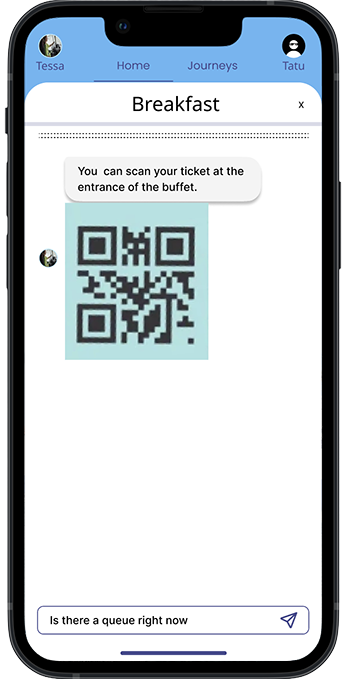
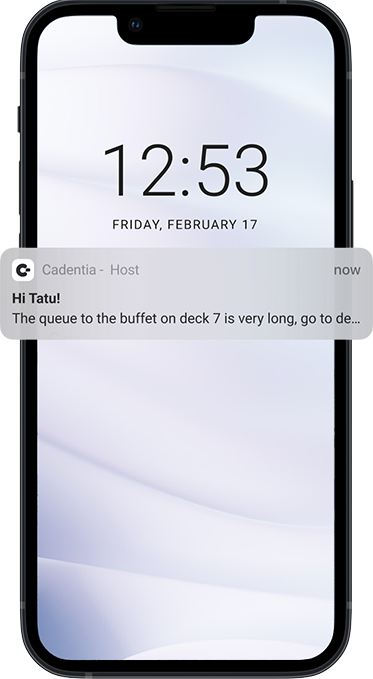
Agentic AI goes beyond traditional bots, but can instead take initiative. For example, it can understand a request to “change my booking and add a dinner reservation,” autonomously access the booking system, check availability, calculate the fare difference, process the payment, and send a confirmation email.
The Passenger Imperative
Insights from Global Travel Trends
To understand the direction of this next-generation development, it is vital to listen to the traveler. While a comprehensive global ferry-specific passenger survey is missing, the insights from the IATA Global Passenger Survey in the aviation sector, alongside findings from the EU’s survey on multimodal digital mobility services, provide a background which the passenger vessel industry can also relate to. As both sectors deal with mass passenger management and complex booking data, the core priorities translate effectively: the modern traveler demands speed, convenience, and seamless, connected journeys.
The IATA survey highlights that 53 percent of travelers prefer to book directly with the operator’s own website or application. This is not about saving money; it is about a desire for direct engagement and a single, reliable source of information. A robust, all-in-one digital platform builds loyalty and encourages repeat business. Customers have understood that online travel agencies and distribution channels mostly just add one extra layer of confusion, especially when it comes to customer service requests.
Passengers are increasingly willing to complete administrative processes before arriving at the terminal to save time and reduce stress. This extends from check-in to even more complex procedures. Travelers want to arrive at the port and board quickly. This goes hand in hand with the passengers´ desire to have all their travel information in one place. The idea of a digital wallet, accessible on a smartphone and containing tickets, booking details, and loyalty points, is no longer a luxury but an expectation, particularly among younger passengers interested in a fully digitized experience.
The Eurobarometer survey underscores a critical pain point with unleveraged potential especially for the ferry industry: A large proportion of respondents in this study conducted in Europe find it difficult to book journeys that combine different transport modes (e.g., ferry-to-rail, train-to-bus), or even journeys with different operators within a single mode. This difficulty is a major barrier to seamless travel and represents a huge, untapped opportunity for any system that can act as the missing link to simplify multi-leg journey booking, thus fostering business partnerships.
To bridge the gap between current system capabilities and passenger desires, the solution must be a service layer that actively manages the complexity of the journey on the passenger’s behalf, proactively streamlining steps and consolidating information.
Agentic AI
The Next Evolution of Digital Intelligence This is where the concept of agentic AI comes to the forefront. It represents a paradigm shift from the reactive nature of current chatbots to a truly proactive and autonomous intelligence.
So, what is agentic AI? Unlike traditional conversational systems that only understand and respond, agentic AI is an artificial intelligence system designed to exhibit autonomy and goal-directed behavior. It is capable of:
- Observing: constantly monitoring the customer’s context, the booking data, external factors (like delays), and the conversation history
- Deciding: autonomously choosing the next best action to fulfill a customer’s request or a predefined goal
- Acting: by directly interacting with the core operational systems (like our Carus Engage reservation platform) to carry out complex, multi-step workflows without continuous human intervention
In simpler terms, it’s not just a conversational tool; it’s an intelligent assistant that takes initiative. For a ferry operator, this means an agentic system can do far more than just answer “What time is my ferry?” It can understand a request to “change my booking and add a dinner reservation,” autonomously access the booking system, check availability, calculate the fare difference, process the payment, and send a confirmation email—all while maintaining a fluid conversation. This is a significant leap beyond traditional, scripted bots.
What Is Agentic AI?
Agentic AI is an artificial intelligence system designed to exhibit autonomy and goal-directed behavior. It is capable of:
- Observing: constantly monitoring the customer’s context, the booking data, external factors (like delays), and the conversation history
- Deciding: autonomously choosing the next best action to fulfill a customer’s request or a predefined goal
- Acting: by directly interacting with the core operational systems (like our Carus Engage reservation platform) to carry out complex, multi-step workflows without continuous human intervention
Scene-Based Conversational AI
Structured Autonomy
It must be clear, of course, that a specific framework must be established within which the AI can operate independently. This is required not only by regional legal frameworks, but also by the individual customer´s willingness to engage and the respective commercial partnerships of the operators. Carus’s approach to agentic AI is therefore focused on a model called scene-based conversational AI, developed in partnership with our technology partner, Cadentia Technologies. This approach provides the crucial structure needed to make AI reliable and trustworthy within a high-stakes operational environment.
Instead of generic chatting, the digital assistant guides passengers through clearly defined “scenes,” such as booking, check-in, travel updates, or onboard services.
Each scene has a clear objective and defined entry/exit criteria. When a customer initiates a support process, the system immediately sets the scene, establishing the purpose of the task. The system has an unparalleled memory and context awareness, securing contextual continuity. It can manage multiple requests in parallel and seamlessly resume interrupted conversations. This eliminates one of the biggest customer frustrations: having to repeat information.
The critical architectural difference is the unified data context, in cases the system´s limitations still require a human handover. Drawing information from the existing Carus Engage platform, the AI shares a unified “customer story” as a human agent—a contextual narrative of all interactions, preferences, and transactions. This ensures that no repeated questions are asked, no data is lost, and the service is consistent whether the user is speaking to the AI or a human.
The Future of Ferry Travel
Scene-based conversational AI is setting a new benchmark for digital ferry service: proactive, reliable, and truly passenger-focused. This is not technology for technology’s sake, but a practical application of Agentic AI that reduces costs, streamlines operations, and enhances the passenger journey every step of the way.

John Bertell combines a hands-on background in car- go, cruise, and port operations with over 20 years of experience in ferry-focused IT solutions. Since join- ing Carus in 2010, he’s been helping ferry operators around the world improve their customer experience and operations. Now director of sales, John works closely with both new and existing clients—always with a focus on practical solutions, long-term part- nerships, and a shared passion for travel.