
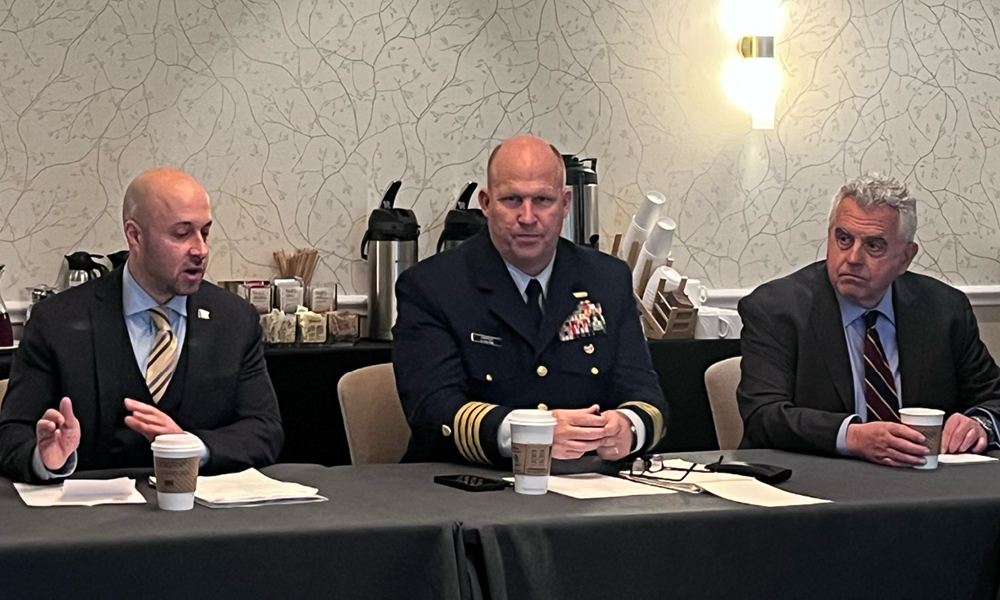
On May 7, 2026, the Passenger Vessel Association (PVA) and the U.S. Coast Guard held the spring Quality Partnership meeting in Alexandria, Va. These meetings are one of the most important forums in the maritime industry, where senior leadership from both sides of the relationship sit across the table and speak openly. This year’s conversation was productive and, in some respects, encouraging. But it also reinforced a concern that has been building for some time, that the Coast Guard’s prevention mission is not getting the attention it requires and that carries real consequences for maritime safety.
During the QP meeting we had good discussions across a broad agenda from mariner credentialing, cybersecurity implementation, the National Salvage and Marine Firefighting Task Force, and the ongoing work between PVA and the Coast Guard to weave the PVA Flagship Safety Management System into the fabric of marine inspection and industry risk management practices. On that last point, PVA has long maintained that a well-implemented Safety Management System (SMS) should be equivalent to the Streamlined Inspection Program (SIP). An operator who has built a rigorous SMS into daily operations should have that recognized by the Coast Guard in the inspection process, rather than running two parallel tracks. We made that case again and it was well received.
These meetings are one of the most important forums in the maritime industry, where senior leadership from both sides of the relationship sit across the table and speak openly.
The QP meeting also gave us a chance to spend time with Rear Admiral Select Rob Compher, the director of inspections and compliance, who is moving into the assistant commandant for prevention policy role as Admiral Arguin transfers to Hawaii. PVA has worked with Rob Compher before, and we believe he understands what the Coast Guard’s prevention mission means for our industry. The assistant commandant for prevention policy is the senior advocate for marine safety and continuity in that position is something we actively work to protect. We congratulated him on his selection and made clear that we have high expectations, as always, for whoever occupies his position.
Beyond our congratulatory remarks, we also expressed concern about issues we perceive as being important to our industry.
The pattern of diminishing Coast Guard resources in the field is troubling. For example, over the past several years, Coast Guard participation in Harbor Safety Committees has declined and Coast Guard presence at industry days has dwindled. Engagement at security meetings that used to bring our operators and local marine safety offices together in the same room are increasingly rare. As operators in places like Chicago, Pittsburgh, and Mackinaw have documented, the small boat stations that serve as the Coast Guard’s front line on the inland waters have been drawn down, and the outreach infrastructure that once connected the prevention workforce to the communities it serves has quietly eroded. These are not abstractions. They represent the day-to-day relationship between federal safety regulators and the businesses responsible for moving millions of passengers safely each year.
Force Design 2028 is accelerating some of these pressures. We have said this before, but it bears repeating that the FD2028 Executive Report does not reference marine safety as a distinct operational mission. The terms “vessel inspection,” “passenger vessel,” “marine inspector,” “certificate of inspection,” and “CG-5P” do not appear in the document. The word “safety” appears once, and only to justify military workforce growth. PVA supports a stronger, better-resourced Coast Guard. We advocated for Coast Guard funding on Capitol Hill this spring, and we meant it.
I believe Congress has a responsibility to ensure that the Coast Guard has adequate resources and direction. The failure to fund the Coast Guard on time was a genuine threat to marine safety. There is nothing more demoralizing to a workforce trying to carry out a complex technical mission than not knowing whether the lights will stay on. We have told members of Congress this directly, and we will continue to do so. It is disgraceful that an agency responsible for the safety of the maritime transportation system, which by the Coast Guard’s own reporting contributes more than $28 billion in economic value to the nation, would sit idle due to Congressional funding inaction.
The PVA/Coast Guard Quality Partnership is representative of what a functioning relationship between government and industry is supposed to look like. It works because both sides come prepared, speak honestly, and follow through on commitments. PVA’s role in this relationship has never been simply to receive information, but it is to push when pushing is warranted, and to bring the kind of institutional knowledge that produces results. We left Alexandria with action items on both sides of the table, and we will track them.
The PVA/Coast Guard Quality Partnership is essential to maintaining effective communications, understanding, and continual improvement. We will be back at that table in the fall.
Sincerely,

Andrew Sargis
PVA President, 2026

Andrew Sargis, PVA President 2026