
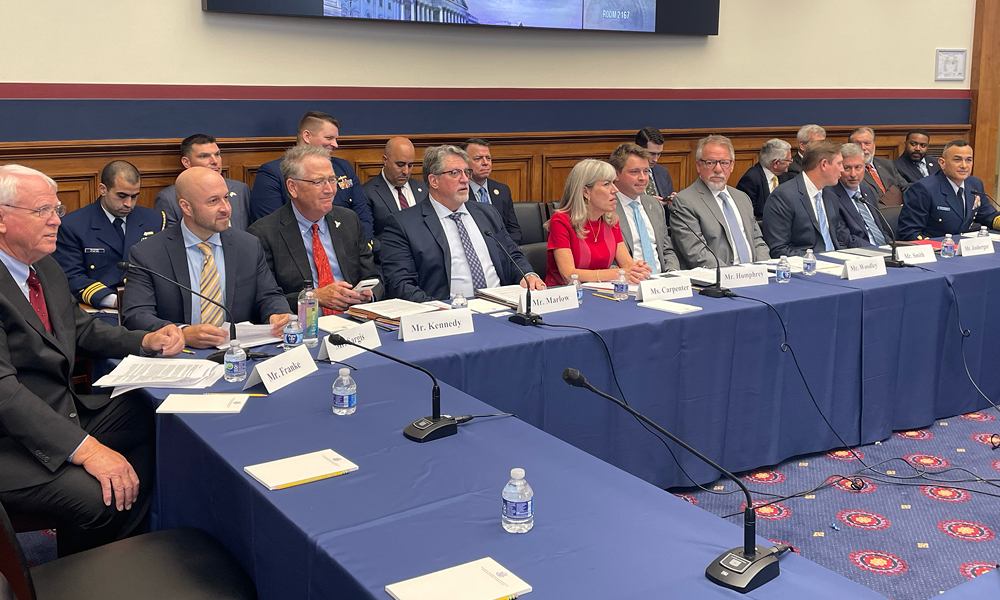
The effectiveness of PVA’s advocacy is measured not only by bills passed or regulations changed, but also by the opportunities PVA creates for passenger vessel operators to speak directly with policymakers. A recent maritime safety roundtable hosted by the House Coast Guard and Maritime Transportation Subcommittee provides an excellent example of how sustained engagement can bring the industry’s priorities before Congress.
During PVA’s annual Congressional Fly-In in April of this year, association members met with subcommittee Chairman Mike Ezell and suggested that the subcommittee convene a discussion focused on the U.S. Coast Guard’s marine safety responsibilities. Chairman Ezell responded enthusiastically and subsequently organized a roundtable that brought together PVA, representatives of several other U.S.-flag maritime associations, and the U.S. Coast Guard. PVA 2026 President Andrew Sargis represented the passenger vessel industry.
The roundtable attracted strong congressional participation. Chairman Ezell, House Transportation and Infrastructure Committee Ranking Member Rick Larsen, Representative John Garamendi, and other members of the subcommittee that PVA members had met during our spring fly-in attended the hearing, offered supportive statements, and asked thoughtful questions. The discussion addressed Coast Guard staffing and resources, the administration’s Maritime Action Plan, support for the Jones Act, the condition of the Coast Guard’s marine safety mission, and the operational challenges facing U.S.-flag maritime companies.
Sargis brought extensive operational experience to the discussion. He explained that the passenger vessel industry safely carries approximately 200 million passengers annually aboard a diverse fleet of U.S.-built, U.S.-crewed, and U.S.-flag vessels. These include public and private ferries, sightseeing and dinner cruise vessels, overnight excursion vessels, whale-watch operations, and other passenger services.
Sargis emphasized PVA’s longstanding and productive partnership with the Coast Guard. Passenger vessel operators work with the Coast Guard every day and share its commitment to safety, professionalism, and public trust. At the same time, he cautioned that the service’s domestic marine safety mission must not become a secondary priority as the Coast Guard responds to expanding national security, border security, and global maritime responsibilities.
The witnesses identified several shared priorities. These included support for the Jones Act as a foundation for strengthening and protecting American maritime capabilities; reopening and adequately staffing Coast Guard small boat stations; maintaining safe waterways; protecting the marine environment; and ensuring that the National Maritime Center and National Vessel Documentation Center can continue performing their essential work during a lapse in federal government funding.
For passenger vessel operators, the Coast Guard is not a distant regulator but rather a daily partner. Vessels cannot operate without timely inspections, and mariners cannot work without timely credentials. Operators also depend on properly maintained aids to navigation, effective search and rescue capabilities, and consistent enforcement of federal safety laws. Sargis urged Congress to fully resource the Coast Guard’s marine safety mission, preserve the continuity of mariner credentialing and vessel documentation services, and direct a comprehensive assessment of aids to navigation maintenance and placement needs on the Western Rivers.
Several questions focused on the reduction or loss of Coast Guard small boat stations. Sargis explained how these closures can weaken search and rescue coverage while also reducing the Coast Guard’s ability to enforce passenger vessel safety requirements. Those diminished enforcement capabilities are particularly concerning as illegal passenger-for-hire operations continue to grow in many ports.
In response to questions from Chairman Ezell, Sargis described what distinguishes a lawful passenger vessel operator from an illegal charter operation. Responsible operators comply with Coast Guard inspection, licensing, manning, drug-testing, and other safety requirements. Illegal operators evade those safeguards, placing passengers at risk while creating an unfair competitive disadvantage for businesses that invest in safety and regulatory compliance.
Sargis also thanked the subcommittee for initiating a Government Accountability Office study of illegal passenger vessel operations. The study, an important PVA advocacy priority, has recently begun to take shape and should help Congress and the Coast Guard better understand the scope of the problem and identify opportunities to strengthen enforcement. Coast Guard Rear Admiral David Barata strongly agreed with Sargis’s description of illegal passenger vessels as a serious and persistent problem and acknowledged the need for greater Coast Guard attention to the issue.
An idea raised by PVA during the Congressional Fly-In became a congressional forum where the association’s president presented passenger vessel priorities directly to lawmakers and senior U.S. Coast Guard leadership.
The roundtable demonstrated what PVA’s continued presence in Washington can accomplish. An idea raised by PVA during the Congressional Fly-In became a congressional forum where the association’s president presented passenger vessel priorities directly to lawmakers and senior U.S. Coast Guard leadership. It also provided an opportunity to identify concerns shared across the U.S.-flag maritime community and build support for practical solutions. PVA will continue working with Chairman Ezell, the subcommittee, and the Coast Guard to advance a safe, strong, environmentally responsible, and sustainable U.S.-flag passenger vessel industry.

Richard Patch is the Legislative Director of the Passenger Vessel Association.