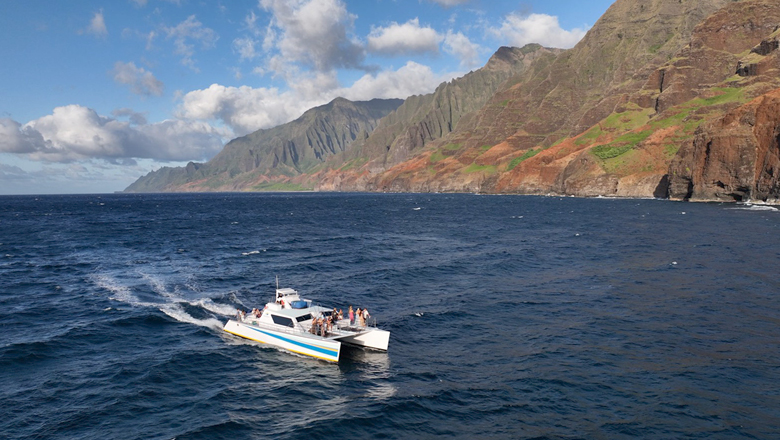
Lush emerald sea cliffs tower 4,000 feet above crystal-clear water. Waterfalls cascade into the ocean teeming with spinner dolphins, green sea turtles, monk seals, manta rays, and migrating humpback whales. This is the Nāpali Coast of Kaua‘i, as experienced from the catamarans of Holoholo Charters based in Ele‘ele, Hawai‘i. Launched in 1997 by Kevin Millett, the company is custom building two new state-of-the-art vessels to replace their fleet and carry Holoholo Charters forward.
Before he arrived in Kaua‘i, Kevin was building and sailing boats across the Pacific Ocean. He took those experiences and applied them to designing and constructing vessels specifically for the open-water conditions and the remote location of the Nāpali Coast. From a former pineapple cannery in Lawai, he founded Holoholo Charters with the company’s flagship vessel Holoholo. Holoholo was the perfect name for both company and vessel as the Hawaiian word means to go for a walk, ride, or sail—traveling and exploring with no particular destination.
The company’s second vessel, Leila, was built by Kevin in 1993 and was used by an operation in Maui. A few years later when the vessel was for sale, Kevin purchased her back, rounding out Holoholo’s fleet.
Though both boats are still in good condition, ten years ago the company began planning their next generation of vessels. Co-owners Kevin Millett and Chandra and Adrian Bertsch made the decision to build the new fleet themselves. Like Kevin, Adrian Bertsch brings years of experience to the project having started constructing boats in his teen years. Adrian, nicknamed Holoholo’s “Boat Boss,” is leading the build. Together, the team combined their background experience with knowledge from lessons learned running the company and guest and crew feedback to develop vessels that will elevate the onboard experience, streamline maintenance, and improve the operation’s sustainability.
They designed the vessels and worked with marine architects and engineers to finalize the plans. Finding land just a few doors from Holoholo Charters, they constructed a warehouse in 2022, and by 2023, the vessel build had officially begun.
The first vessel to launch will be Holo Nui. Chandra explained that nui in Hawaiian means grand or important but can also mean fast. The team likens it to an upgraded, bigger version of Holoholo. Holomua, the sister ship, means to progress or move forward, and was inspired by the company building on what they’ve learned to move forward with the second edition.
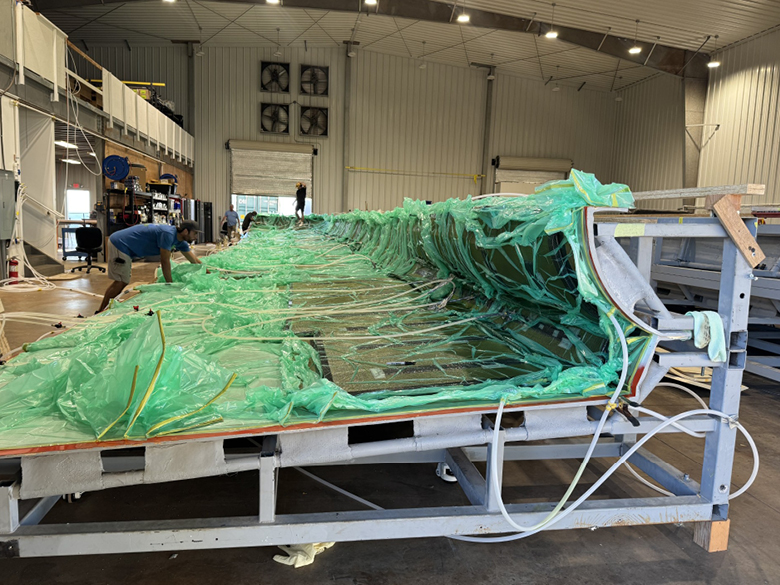
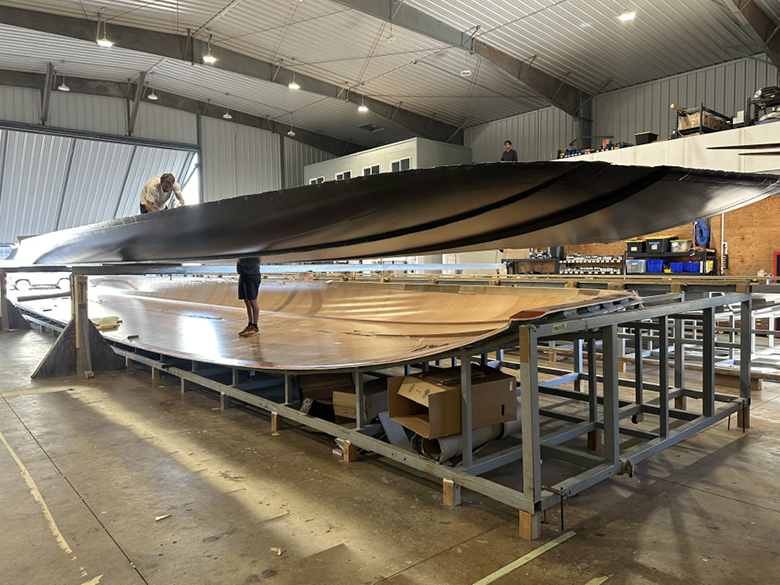
The defining feature of the new vessels is the company’s decision to build them using carbon infusion, which means they are built using a vacuum resin infusion process with carbon fiber reinforcements. It is a first for a leisure boat company to utilize this material in their vessels. Attending a multi-week course to learn the process, Adrian was in class with people from companies like Boeing and SpaceX.
The defining feature of the new vessels is the company’s decision to build them using carbon infusion, which means they are built using a vacuum resin infusion process with carbon fiber reinforcements. It is a first for a leisure boat company to utilize this material in their vessels.
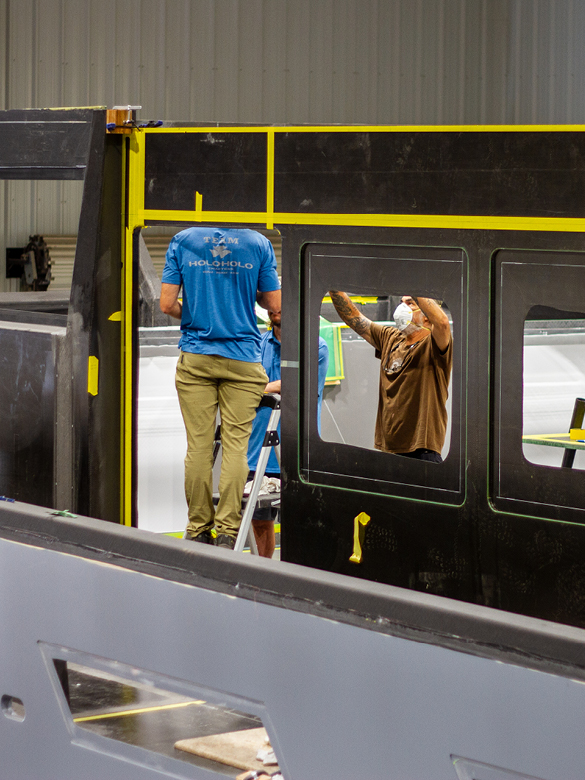
Their engineering firm connected them with a boatyard in Rhode Island that builds carbon infusion yachts. Millett and the Bertschs recognized that the material, size, and style of the vessels are new to them and have found the company in Rhode Island to be a mentor throughout the process. The company built a few pieces for Holoholo Charters and have even had a couple people on site to offer hands-on support. “We have a team of about eight or so full-time boat builders on our staff, and then we add two-plus depending on what we need from the carbon ocean yachts team,” Chandra said.
As carbon infusion is relatively new in this sphere, Holoholo Charters has been working closely with the U.S. Coast Guard throughout the process. The Coast Guard has been involved in almost every step, working with the team to get them timely answers and approvals along the way. Adopting a newer technology and working through the regulations has at times has added to the timeline for the Holo Nui build, but the team expects that once this ship is complete, the process for Holomua should be easier.
Carbon infusion will allow the team to build larger vessels that are strong and lightweight, with the new 75ʹ Holo Nui expected to weigh the same as the 65ʹ fiberglass Holoholo. The additional 10ʹ in length will make a significant difference for both guests and crew on board. On the current vessels, there is not enough room in the indoor space onboard for all 49 passengers, the maximum number local regulations allow for Nāpali Coast tours, to be seated inside. This won’t be a limitation on the new vessels which will have indoor seating to accommodate all guests. The enclosed space will include table seating for everyone making it more comfortable to enjoy meals during cruises.
Carbon infusion will allow the team to build larger vessels that are strong and lightweight, with the new 75ʹ Holo Nui expected to weigh the same as the 65ʹ fiberglass Holoholo.
Aisles and walkways will be wider throughout the vessels, making it easier for passengers and crew to move about. Consideration was given to guests’ belongings with more storage included for bags, towels, and other items. The vessel designs take into account every detail the team loves or doesn’t about the current fleet to create an optimal experience for everyone stepping on board.
The 10 extra feet in length will also mean a smoother, more stable ride. “Instead of rolling up and down with the waves,” Chandra explained, “we should be able to slice through more of them.” They also put a trim foil under the vessels to help improve the ride.
Both new vessels will be motorboats, as opposed to the current fleet—Leila is a sailboat. While the team has a passion for sailing, the distance traveled on some of their tours is too great to be accomplished under sail in a daily tour setting. On some days, weather conditions mean that Leila can’t sail at all and with her they can only operate tours of four or five hours. Their signature tour is a seven-hour trip to Niʻihau, the “Forbidden Isle”, 17.5 miles southwest of Kauaʻi.
Between the vessel length and the motors, the team will be able to deliver the best possible guest experience. Chandra noted that many people don’t fully understand that the tours travel across open, exposed ocean which means they are at the mercy of strong elements. “We deal with a lot of wind and swell. Sometimes it can be cruising on a lake and sometimes people might say it’s ‘Victory at Sea,’” she said. “It can be it can be adventurous.” The new vessels will give the team the best equipment to offer a more comfortable ride in varying conditions.
As the designers and boat builders, Millett and the Bertschs know these vessels inside and out which will mean they can maintain the boats themselves. They will have the knowledge and in-house talent to fix or repair anything that needs attention over the vessels’ lifespans. With the warehouse, they also have the indoor boat building space to do so.
Millett and the Bertschs know these vessels inside and out which will mean they can maintain the boats themselves. They will have the knowledge and in-house talent to fix or repair anything that needs attention.
Being sister ships is also a significant improvement when it comes to maintaining the vessels. The current vessels are quite different which means needing unique spare parts for each. Although they may make slight adjustments on Holomua after they begin operating Holo Nui, the ships will be close enough to identical to make maintenance much more efficient.
With maintenance in mind, they limited the amount of stainless steel on the vessels. As this material rusts over time, they took it out of the equation whenever possible, doing gunnel walls instead of railings for example. Chandra pointed out that there are few welders on the island which has been a concern with stainless steel.
Operating in Hawai‘i, sustainability is at the core of Holoholo Charters. In addition to choosing carbon infusion which allows for larger vessels that weigh the same as their current boats, the team is looking to improve the operation’s sustainability by transitioning to biodiesel. They considered biodiesel in 1997 but ran into roadblocks such as lack of availability. Chandra explained that there were also engine components that they found didn’t handle the fuel well when they tried it nearly 30 years ago. Today, a biodiesel company started on Maui has expanded to Kauaʻi making the fuel more accessible and a realistic option for the operation. They are also hoping for more pricing stability with the fuel switch.
They considered biodiesel in 1997 but ran into roadblocks such as lack of availability. Today, a biodiesel company started on Maui has expanded to Kaua‘i making the fuel more accessible and a realistic option for the operation.
A significantly longer lifespan for the new builds adds to the company’s long-term sustainability efforts. The current boats have an expected life of 30-50 years, whereas the fleet under construction is estimated to last anywhere from 80 to 100 years.
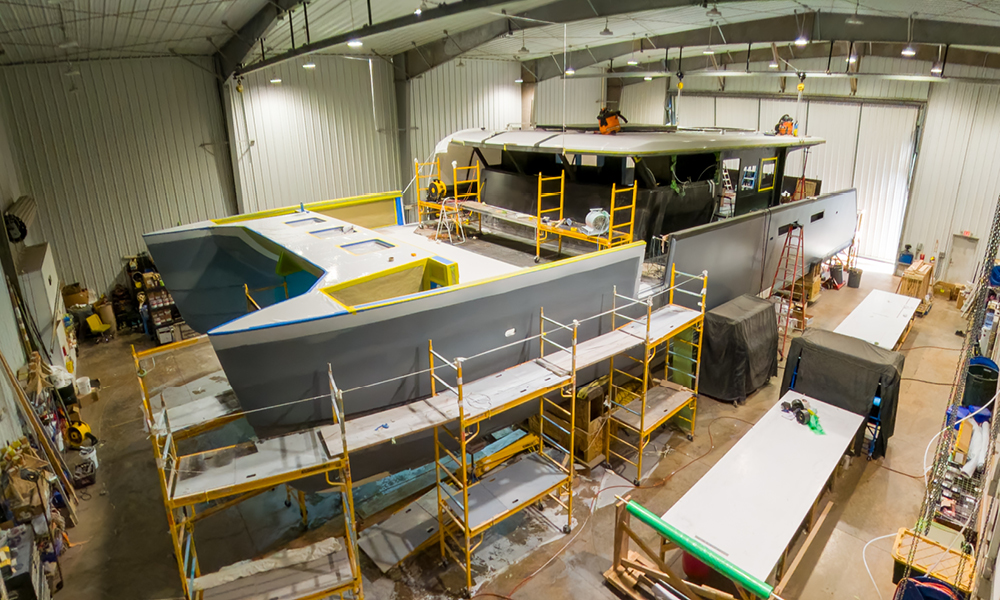
With Holo Nui in the final stages of construction, Chandra looked back to when they first began planning to build a new fleet. Though Kevin and Adrian have a passion for and background in boat building, Holoholo Charters was not a boatyard, and she noted that there has been a learning curve to taking on the build themselves. “When we were plotting this on a notepad 10 years ago, none of us could have anticipated the full amount of time and cost that goes into this,” she said. It’s been a long-term goal that they’ve saved for, and they’ve sourced additional funding through loans and grants, as well as participating in the Capital Construction Fund. She noted that they’ve gained tremendous knowledge and understanding through the process of building and funding the first vessel which will only aid them when they move on to construction of Holomua.
Their passion and determination has paid off with Holo Nui scheduled to launch this fall and the team hoping to start running tours on the new vessel by year’s end. As many pieces for the boats are constructed from molds, there have been times they could conveniently build parts for both new vessels at once. So, although official construction of Holomua will begin after the first vessel is complete, the next boat is already partially in progress. The team anticipates completion of the second vessel in 2029.
Once fully underway, celebrations will mark this milestone for Holoholo Charters. Chandra said they plan to have days dedicated to inviting the local community on board, as well as a broader outreach to travel agents. While fun events lie ahead, right now, the focus is on the final touches to get Holo Nui launched. Chandra noted that the team “really looks forward to seeing her come alive.”