
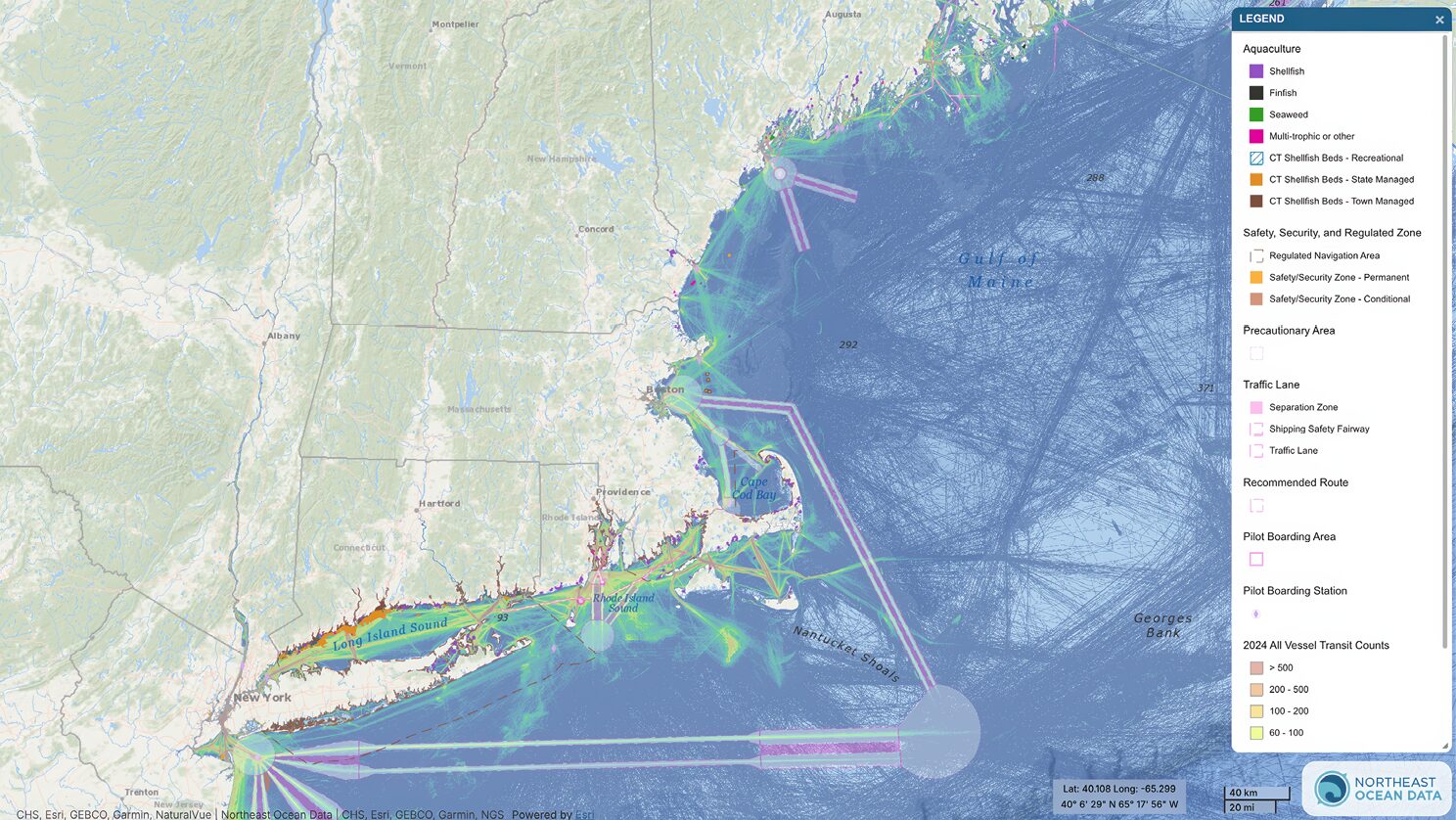
Navigating the increasingly complex ways we use, manage, and conserve the nation’s ocean and coasts requires efficient access to relevant information and robust coordination among governments, industries, communities, and other partners. While likely unfamiliar to many Foghorn readers, Regional Ocean Partnerships (ROPs) play an important role providing an opportunity for the maritime industry and others, to represent their interests in the management, planning, and responsible use of U.S. ocean and coastal waters.
ROPs are voluntary organizations established by state governors to coordinate coastal states, federal agencies, tribes, maritime industry, and other ocean users to advance data and information sharing, support decision making for planning and management, and coordinate to achieve regionally defined priorities. There are currently four ROPs—in the Northeast, Mid-Atlantic, Gulf Coast, and West Coast—with the perspectives, priorities, and methods defined by participants in each region. All ROPs focus on data and information as well as coordination needed to advance more informed decision-making related to both government and business decisions.
ROPs were established because economic activities and environmental issues of different scales increasingly overlap, cross jurisdictional boundaries, and require regional collaboration for effective management. For example, coastwide shipping lanes may interact with localized fishing areas, regional offshore energy zones may affect navigation routes, and trans-Atlantic telecommunications cables may be proposed near local anchorages or commercial aquaculture operations. To address these types of issues, the ROPs emphasize:
- Shared spatial data and information that help inform resources, activities, and uses
- Coordination across states and with federal and tribal partners, depending on the region, to align ocean and coastal management approaches
- Ocean user engagement and transparency so business and government alike have access to the same baseline of information
- Support for decision making such as permitting, planning, siting, dredge and disposal, energy, navigation, and fisheries management
- Transparency and public engagement
The Northeast Regional Ocean Council
New England governors established the Northeast Regional Ocean Council (NROC) in 2005 to inform and coordinate the work of their states, federal agencies, tribes, Fishery Management Council, and regional partners. The interests of marine industry are strongly represented.
NROC and the other ROPs serve as both facilitators and innovators, ensuring that management solutions reflect the knowledge and interests of marine industry. For ports, passenger vessels, ship operators, recreational, and other maritime interests, NROC serves as a conduit between state agencies, federal regulators, and industry—so that maritime interests are consistently engaged, future uses and trends are factored into decision making, and the interests of other ocean uses are understood.
In addition, when ocean projects such as dredging, buoy modernization, energy facilities, submarine cables, or aquaculture operations are proposed, the availability of accurate maps that illustrate ocean uses and resources reduces uncertainty and supports timely decision-making. Data and information acquired, vetted, and maintained by NROC on the Northeast Ocean Data Portal provide a comprehensive picture of natural resources and offshore activity for any given location in Northeast waters.
Northeast Ocean Data Portal
The Northeast Ocean Data Portal provides free, user-friendly access to interactive maps and data on the ocean ecosystem, economy, and culture of the Northeast that have been developed and reviewed by experts in the region. Over 6,000 spatial data layers outline the richness and diversity of the region’s economy and ecosystem and illustrate the many ways that humans and environmental resources interact. Portal users can view maps and data by topic, create custom maps, download data for use in other applications, stay informed about government agency actions, and use maps to support public comment and industry advocacy.
To understand and accurately represent the maritime industry’s interests as an ocean user, NROC engages with the industry—including the U.S. Coast Guard, recreational boating and fishing, port operators, and shipping interests. For example, NROC works with the industry to understand how AIS vessel‐traffic data and transit corridor information can be mapped for optimal value including vessel-type breakdowns, transit densities, and integration of operational data into the portal. This ensures that the portal provides accurate, actionable information related to the maritime transportation sector, such as:
- Aids to Navigation and Waterway Planning: Users can overlay new buoy, aids, and waterway proposals with AIS transit density layers and existing navigation areas to assess whether changes may affect shipping or passenger-vessel traffic. The Northeast Ocean Data Portal now includes vessel transit data by type which is directly useful for such reviews.
- Port Access Route Studies (PARS): The U.S. Coast Guard can draw on transit-density and other datasets from the Northeast Ocean Data Portal to provide a broader regional context for port access studies, including multi-use considerations such as energy, pipeline, cable, or aquaculture siting.
- Aquaculture and Marine Transportation Interactions: Proposed aquaculture zones or projects may overlap or conflict with major vessel routes. The Northeast Ocean Data Portal includes maps and data depicting aquaculture and marine transportation, supporting better aquaculture planning and enabling maritime operators to engage earlier in siting decisions.
- Energy, Telecom, and Cable Infrastructure: Vessel operators benefit from transparency around submarine cable corridors being sited in New England, especially for tug-tows, service vessels, and maintenance traffic. The portal data support spatial analysis of these corridors alongside marine vessel transit patterns.
- Marine Research and Emerging Uses: Emerging technology including autonomous vessels, unmanned surface vehicles, and new sensor networks may require coordination with existing maritime traffic. The data from the Northeast Ocean Data Portal help identify current usage density and can assist the broader maritime industry and specifically ports in future-proofing design and siting decisions.
- Marine Transportation System Understanding: The layering of AIS traffic, port calls, fairways, hazard zones, and seabed bathymetry provides a richer understanding of the regional marine transportation system.
Portal users can view maps and data by topic, create custom maps, download data for use in other applications, stay informed about government agency actions, and use maps to support public comment and industry advocacy.
Our use of the marine environment is evolving rapidly. New and emerging uses will have to share ocean space that will require improved spatial awareness of uses, users, and resources. For the Passenger Vessel Association, early coordination with NROC and other ROPs offers a strategic advantage: better situational awareness, earlier engagement in siting/planning processes, and improved ability to articulate and defend operational interests when new uses or regulations are being evaluated.
OTHER REGIONAL OCEAN PARTNERSHIPS
To learn more about or to engage with ROPs outside the Northeast, please contact:
- Gulf of America Alliance
(Fla., Ala., Miss., La., Texas)
gulfofamericaalliance.org - Mid-Atlantic Regional Council on the Ocean
(N.Y., N.J., Del., Md.,Pa., Va.)
midatlanticocean.org - West Coast Ocean Alliance
(Calif., Ore., Wash.)
westcoastoceanalliance.org