
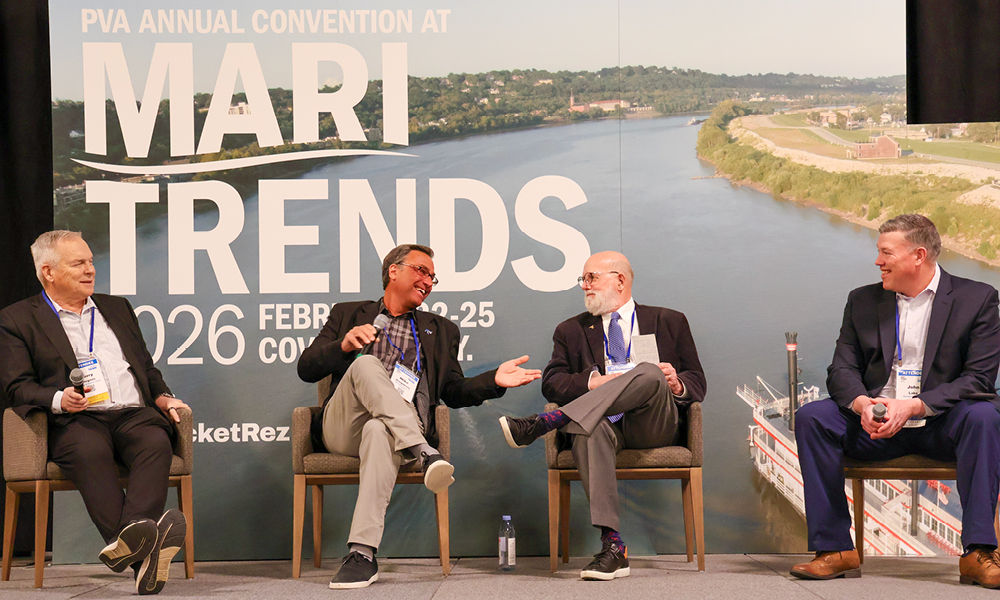
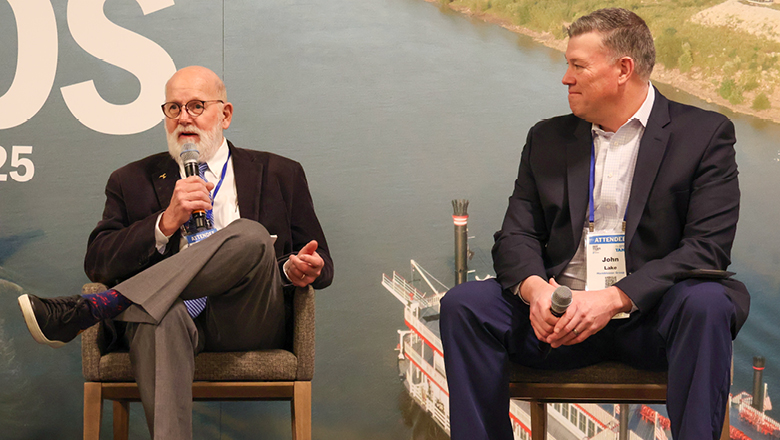
Three legends of the passenger vessel industry came together on stage at this year’s PVA Annual Convention at MariTrends 2026 to talk about PVA, the key role it’s played in shaping their careers and the industry, and to share their experiences and advice for upcoming mariners and leaders. Terry Wirginis of Gateway Clipper Fleet in Pittsburgh, Mike Borgstrom of Wendella Sightseeing Boats in Chicago, and Gary Frommelt of Manthey Hospitality in Tampa, were joined by moderator John Lake of City Cruises by Hornblower.
Wirginis: By the time I got to high school, I said, “This is the last thing I’m doing with my life.” I went on to Ohio State University and got a degree in animal science, with a minor in biology. My granddad kept calling me back, and finally, after a few years, I took the bite and came back to work with him in 1979.
My involvement with Passenger Vessel Association started back in 1981. The group that first got together in 1971, amounted to 18 folks from 18 different operations, a lieutenant from the U.S. Coast Guard, and Jim Swift. They got together basically for insurance purposes, and they wanted to better have a relationship with the Coast Guard.
Our old general manager, Zack D’Alesandro, and I heard about a meeting in 1981. We went down to Sarasota, Fla., and we got together with about 34 people. There were no exhibits. Most of the old crew was there from 1971.
At that point it was called NAPVO, the National Association of Passenger Vessel Owners. Owners was the key word. As I went through, it became a second generation of people involved in the association. We began to recognize that the word owners no longer reflected this organization. We said we need to broaden our perspective. We had people who were employees that were really running most of the positions of the organization. When I was president in 1993, we were able to change the name to the Passenger Vessel Association. I look at that as one of the big things that I was able to accomplish on my watch.
Perhaps the most important thing was back in 1988. As we were getting into issues with the U.S. Coast Guard, the board assigned Alan Bernstein and me to find somebody that could represent and work with us. Alan and I were sent down to Washington, D.C. I think we had 37 resumes of retired Navy, retired Coast Guard, and naval architects. One person stood out far above everybody else, that was Pete Lauridsen. Everybody else told us what we needed to do. Pete actually listened to what we had to say, interpreted it, and then came back to us and said this is what we need to do. It was no doubt who we were going to recommend, and thankfully, the board made the decision.
When we interviewed him, we didn’t recognize how much respect he had within the Coast Guard. He’d been a career person; it gave us immediate credibility that we never had before. Where we couldn’t get a lieutenant from a district office to come to visit us for the convention, all of a sudden, we had admirals there. We were going have the commandant here this week, except for the government shutdown. I think that’s all because of Pete.
Lake: The next person on stage here is Mike Borgstrom, Wendella Sightseeing Boats, president, owner, third generation of a family business.
Borgstrom: We used to have a saying, and I’m sure many of you had a similar saying. We’ve got about 72 stairs that come down from Michigan Avenue to our dock, and if you rolled down those stairs drunk and were able to get up, you were hired as a deckhand. That’s how we got a lot of our crew. I’m not exaggerating either.
So, it is amazing how things have evolved over the years. I have to give so much credit to PVA for that. I got involved with PVA in the 90s. Getting involved with PVA really changed everything for us as a company. We really ramped up things, especially with safety.
“Hospitality is important and regulations are important, but don’t try to cut corners on safety. You start with that and everything will grow from there.” Mike Borgstrom, Wendella Sightseeing Boats
Safety is dear to me. I joined the PVA Safety and Security Committee and eventually became chair of that committee. We cranked out so many products for this organization, many that you may or may not know came from the Safety and Security Committee.
There’s a real commitment building through businesses, starting with the safety. Hospitality is important and regulations are important, but don’t try to cut corners on safety. You start with that and everything will grow from there.
I started in the business officially in 1977 as a deckhand. I’ve been a license bearer since ’81, we had two boats back then. We have 10 vessels now, docks all over the Chicago River, multiple K-boats, we run water taxis, and things like that. I credit PVA for all of that because I learned so much here over those decades that we applied to what we do every day.
If you’re not a member of a committee, join one, because that’s the best way to see the true value in this organization. Whether it’s regulatory, legislative, safety and security, membership, whatever it is, get involved and participate.
I was president of PVA in 2008. I was involved with the group with Gary and several others putting together the ASP. Also, the Green Waters Program was a result of my year as president; it was completed the next year.
Lake: I am pleased to introduce Gary Frommelt, vice president of development for Manthey Hospitality. I’m sure most of you know Gary. He’s worked for multiple different companies within PVA. All these gentlemen are past presidents of PVA.
Frommelt: I may be the odd man out here because I am not an owner. I’m an employee. I always have been. I grew up in a little river town on the upper Mississippi. My grandfather ran a button factory and plastic buttons wiped out the family business, so I had to go a different direction.
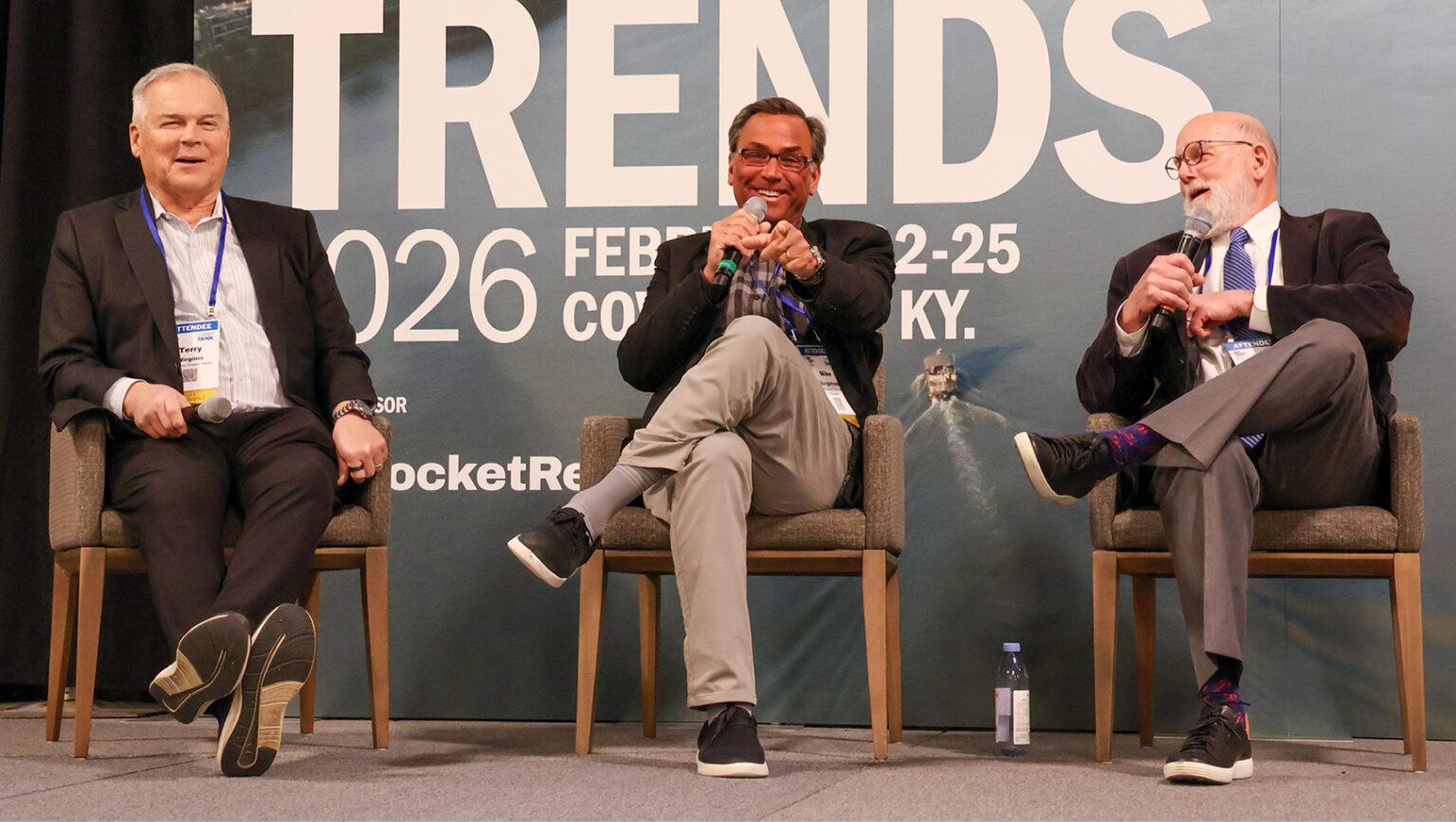
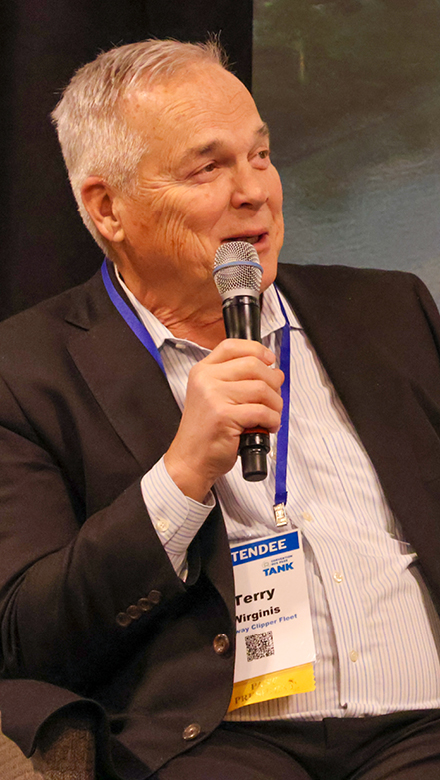
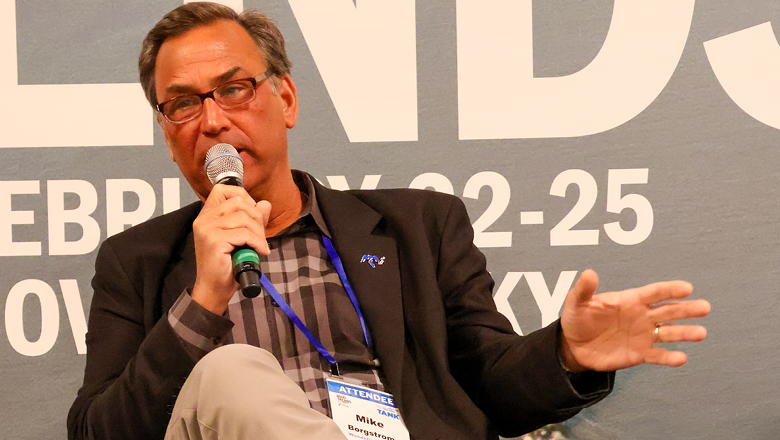
It’s weird because in a small river town everything you did functioned around the river. I delivered newspapers and went to sell them to towboat people. I ended up working towboats in summers to help pay for college, majored in geology, and immediately went to work on an old steamboat. I ended up going in the engine room and stayed there, pursuing my chief engineer’s license, worked boats for many years, and then moved into management.
My first PVA meeting was on the Cotton Blossom. I was working for New Orleans Steamboat Company, and Bill Dow had set up a meeting with Admiral Joel Sykes. I remember it was a big deal. I was like, “This guy’s an admiral. Holy crap.”
My observations early on, not being an owner, we were lucky as employees to be able to attend stuff. There were people that felt like, “Why do I want employees involved in making decisions about my business, knowing all this?” Or “Why would I have a forum like this to share information, to give business tips to my competitor?”
I’m so thankful that culture eroded rather quickly. I wouldn’t be here today if it wouldn’t be for PVA and all the great people I’ve worked for. There’s such a spirit of generosity to share information. We may be in the same court as competitors, but what affects one of us affects all of us. We’re here to support each other, learn from each other, and that information is invaluable.
I was PVA president in 2003, a founding member of the Safety and Security Committee. It was quite an honor and a little bit intimidating. In my time early on, it was, I felt—you can refute this, Terry—a bit of a good old boys club.
Wirginis: It was definitely a good old boys club.
Frommelt: It’s amazing how the association has grown and really become a great functioning machine. Very few staff at that time, and now an incredible staff that does so much work, which is really a benefit.
“You need to know your Coast Guard team. If there’s a problem, you want to make sure that if you have to talk to them at 10 o’clock on a Saturday night that you don’t spend 15 minutes explaining who you are and what your operation is.” Gary Frommelt, Manthey Hospitality
I want to stress the relationship with the Coast Guard. I use a line with my crew all the time. It’s a little corny, but I said if there’s a blue suit coming down the pier, if you have your house in order, all you should worry about is, is the coffee fresh. You have to nurture those relationships. Even at City Cruises, when I was there, we had a lot of ports, and I made it a point twice a year to try and visit the Coast Guard office. I’d try and get to the highest-ranking person possible. I said, “I just want to stop by, put a face on the name, and get your read on how our operation is going.”
You need to know your Coast Guard team. If there’s a problem, you want to make sure that if you have to talk to them at 10 o’clock on a Saturday night that you don’t spend 15 minutes explaining who you are and what your operation is. When I was working for Terry in St. Louis, I got to the point where the Coast Guard would call me. We were a resource for them in many ways and those are the kind of relationships you want to build.
Eric [Christensen] always said, if you have a problem, don’t be afraid to challenge the Coast Guard, work your way up the chain of command. I agree 100 percent. The only advice I give is make sure you’re right. If you’re upset about something, walk around the block before you make that call.
Lake: What’s a cautionary tale for somebody getting started in this business? Either a positive piece of advice or I made this mistake along the way, and I wish I’d have done something different.
Wirginis: Never get ticked off too much in front of your OCMI about him. Like Gary said, walk around the block. One time, I suffered for it a lot. His commander was in charge of our zone, and we got in an argument. I thought he was dead wrong. I still believe he was wrong, but I challenged him inappropriately. I paid for that one for a long time.
Borgstrom: I regret not embracing and being more involved with the Coast Guard early on. I think it was also a generational thing from my grandfather to my father. It was always the Coast Guard was the enemy. There was very little preparation for a Coast Guard inspection. The Coast Guard showing up, that was the inspection. You guys find it.
I eventually changed that mindset, got more active, and got to know the inspectors. For anybody newer to the business, you got to have those relationships. I developed those over the years and then Mike McElroy has taken it to another level.
We have relationships with the Coast Guard all over the country now. We talk about our harbor safety committee. Mike can get on the phone and call somebody. The Coast Guard calls Mike and asks him things now. I only regret the fact that we didn’t do that sooner because that has definitely improved how we approach things. We look at ourselves as trying to set the standard for the industry.
Frommelt: When I went from New Orleans to St. Louis, Terry said we want you to be director of marine operations. I’m sort of young, all pumped up. In St. Louis, they were just wrapping up a repower on a boat. I can’t remember what the issue was, but they were all gassed up. The Coast Guard’s not going to let us sail. We had a big weekend coming up. They can’t get an inspector out tomorrow.
Tim Josiah was captain of the port. I was able to finagle a meeting with him. I charged in there, explained the issue, and said we really need to sail. I can’t remember the exact details, but basically, I was wrong. I listened to the team; I didn’t do my own homework. They were a little emotional and hadn’t done their homework. He allowed us to sail. It wasn’t a safety issue but was some step in the inspection.
I really screwed up. That’s why, “go walk around the block before you call.” I went up to him after the weekend and apologized, and he was impressed with that. It had a big impact on me to see the result of that, and we became great friends. It was a major learning point for me in my career.
I wanted to mention, as an employee, the support I got, how important people are. Take care of your crew. As an employee, you need to take care of your owner and operator. I like an environment where there’s opportunity to express my opinion, but at the end of the day, I know who I work for. I’ve been very fortunate to work for people that always wanted to do the right thing. Terry told me at one point, “Anybody with money can buy a boat, but that’s not what makes you successful. It’s the people you put on it and how you take care of them that really makes your company a success.”
Lake: In your career coming up, how important was it to find a mentor, to help you understand and learn about the business?
Frommelt: I think it’s huge. It really inspires you to learn, to expand, to stay in the business. I’ve had some great mentors over the years. All those people had a major impact on me, made my life better, and taught me a lot on the way.
“I would say bring more people than you could afford. They find out this is just not a little boat operation in Pittsburgh, Pennsylvania. This is an industry, and there are so many people, there’s so much to learn.” Terry Wirginis, Gateway Clipper Fleet
Captain Hawley in New Orleans said, “One of the things I look at to gauge my success in the business is how many people followed in my footsteps? How many people have I taught and brought along? That’s really the most rewarding part.” I’ve been fortunate; I wouldn’t be where I am today without some of the people that have taught me along the way.
Borgstrom: Being a family business, my mentor and I lived in the same house. It was my father. I learned everything there is to know through him. I’ve done every job there is to do and learned every skill there is to learn through my father. He was a great mentor.
Wirginis: Probably my three most important mentors would be my grandfather, John Connelly, who had the faith in me to bring me back to Pittsburgh when I was 26 years old, and put me in charge. We’re trying to build boats and I’m trying to get people to bend to my will. Then I got a technique that’s ask them first what they think they would do and then you kind of work it around, make it their idea. It works pretty well.
Second, Zack D’Alesandro, who was our general manager. He was going to be let go the day I came in, and I was going to become general manager, which would have been like chickens to the slaughter. But there was a flood, and somehow John Connelly had the wisdom, even though he didn’t like Zack at that point, to keep him on because he realized he was the only one that could really handle the flood watches, set up the organization.
I’m around for a few weeks; Zack thought I was just another family member hanging around. Over time, I gained respect. After a couple months I told my grandfather, “Zack D’Alesandro is the only guy in this whole outfit that really has the interest of the Gateway Clipper at heart.” Until he passed in 2013, he [D’Alesandro] was a big part of my life.
The other one was Floyd Ganassi. My grandfather got me in touch with Floyd at one point. For some reason, Floyd took me under his wing from a business standpoint. I learned so much from him about how to handle big situations and not be afraid and just go do it. Nothing to do with the boat business, but it had everything to do with life.
Lake: Is there any trend or change in the industry that the next generation coming in has maybe missed the mark on it and you want to make sure doesn’t get lost?
Borgstrom: I think we’re in a society where a lot of stuff is being driven by social media. I don’t mean like sales and marketing but forming opinions and learning from social media. With the advent of AI, a lot of people are becoming more reliant on that. What I see in general is AI might be great for some things, but it can’t replace wisdom—that’s acquired over time.
There’s a lot of collective wisdom here. If there are people that can share that wisdom with you, I would advise that you listen to that and not look so much to all these other forms.
Wirginis: Well said. Study history. History doesn’t necessarily repeat itself, but it certainly rhymes, as they say.
Frommelt: I’ll just share, Mark Twain said, “Wisdom may come with age, or age may come alone.”
Lake: We’ve talked a little about how PVA has evolved over the years. It started out as all owners, and now there’s probably as many employees as there are owners here. What advice would you give to them as somebody coming to the table and being able to take advantage of what PVA has to offer?
Wirginis: I would say bring more people than you could afford. I have 11 people here, counting myself. It is expensive, but they gain so much knowledge. They find out this is just not a little boat operation in Pittsburgh, Pennsylvania. This is an industry, and there are so many people, there’s so much to learn. Get as many people as you can to the conferences, to the regional meetings, get them involved. Get those folks involved in the committees. And don’t be afraid. You’re going to lose some to somebody else, but what you gain is so much more important from a standpoint of rounded knowledge and not having to do everything by yourself.
Borgstrom: Exactly. We’ve been doing this for many years; we don’t know everything. Individuals that we bring along have certain areas that they may know more than you. I’m a big believer of getting everybody in the room and asking everyone’s opinions on what they think, so the more they know, the better educated decisions can be made.
Frommelt: The great thing about this is networking. No matter what your issue is, there is somebody here that, well, everybody here is going to have an opinion, but you learn so much. There’s such a brain trust here with all the attendees and the associate members. It’s really beneficial to tap into that knowledge phase.
Borgstrom: You, what did you say, got 11 people here? I guarantee you when you get back to the office, you’ll have at least 11 different ideas that you got from the trade show floor, from one of the sessions, or anything like that. For those of you who are employees here, don’t be afraid to share ideas or thoughts you have, because there’s no such thing as a bad idea. Run it by when you get home because that leads to a lot of good things sometimes.
Lake: That question was basically, are the new dogs teaching the old dogs any tricks?
Borgstrom: Yes, they are. We tried things in the past and they didn’t work. They can look at that through a different set of eyes and go, “What if we did this?” Same idea, different twist on it, different perspective. Just because we did things for this way for 90 years, doesn’t mean it’s the right way.
Things evolve over time. We look at social media; that’s such a huge part of everyone’s businesses which didn’t exist before. I don’t fully understand it, but I know it’s important, and that’s fresh perspective. There are a lot of new ideas out there because the industry is constantly changing and evolving. If you don’t change, evolve, you’ll die. You can’t be stagnant. The next generation is to make sure we don’t end up being stagnant.
Wirginis: Even cruise ideas. We have a lot of young staff that come up with some really good ideas for some new cruises and different kind of entertaining cruises. I’ll try anything one time.
Frommelt: As much as I’d like to deny it, the older you get, the harder it is to be flexible and not get set in your ways. New people and younger people coming in, you hire them for that enthusiasm and those new ideas. In my time coming up, if I had an idea, I worked with or for people who were open to hearing it. If it was a dumb idea, they politely taught me why that wasn’t the greatest idea, and I learned. I was smarter the next time I had an idea.
If you shortstop people that are bright and enthusiastic, they’re probably going to move on, or they’re going to quit suggesting things. Not every idea is great. You can’t run your operation by committee, but you need to foster an environment where new, fresh people who are learning and want to do a good job have an opportunity to air what’s going on in their head.
Lake: Gentlemen, thank you very much. This was fantastic. I’ll say one other quick thing. My time with PVA, I think the sessions are phenomenal and have so much value, but if you have an opportunity to talk to these guys or any of the other folks that have been around PVA for a long time listen to the sea stories, listen to some of the stuff that maybe doesn’t come up in the sessions. You can learn a ton from that, there’s a wealth of knowledge here.
Wirginis: I tell a lot of stories about our company; it really helps everybody in our outfit understand what our outfit is all about. It’s worth taking the time with your people. Know everybody by their first name. Try to know how many kids they have. Welcome them when you see them, when you walk across the dock, and tell them stories.