
I can’t believe that I am sitting here writing my final Foghorn article as PVA’s 2025 President. This year has truly flown by.
Looking back on 2025, the association focused heavily on regulatory reform, safety enhancements, economic growth, and sustainability. It is impossible to sum up the entire year in just one article but here are a few of the highlights.
Advocacy And Regulatory Reform
The primary focus of the 2025 term was urging federal authorities to reduce outdated regulatory burdens.
Regulatory Relief
In October 2025, PVA formally called for broad reforms to improve industry efficiency, specifically targeting the Transportation Worker Identification Credential (TWIC). The association argued that TWIC is costly and offers limited security value for many domestic operators, suggesting that the existing PVA Alternative Security Program more effectively addresses safety concerns. Other topics include relief from certain reporting requirements for Vessel Incidental Discharge Act (VIDA) and providing more flexibility to extend the five-year drydock interval regulation, just to name a few.
Legislative Engagement
The 2025 PVA Congressional Fly-In took place on April 29, bringing together PVA members and staff who met with members of the U.S. Senate and House of Representatives, or their staff, to discuss industry concerns including a fully resourced U.S. Coast Guard safety mission, increasing funding for the Small Shipyard Grant Program, bolstering the U.S. maritime industry through the SHIPS for America Act, and advocating for additional federal investment in ferry programs such as the Federal Transit Administration (FTA) Passenger Ferry Grant Program and the Federal Highway Administration (FHWA) Ferry Boat Formula Program.
Safety And Operational Excellence
Safety remained one of the association’s core missions throughout 2025.
Coast Guard Partnership
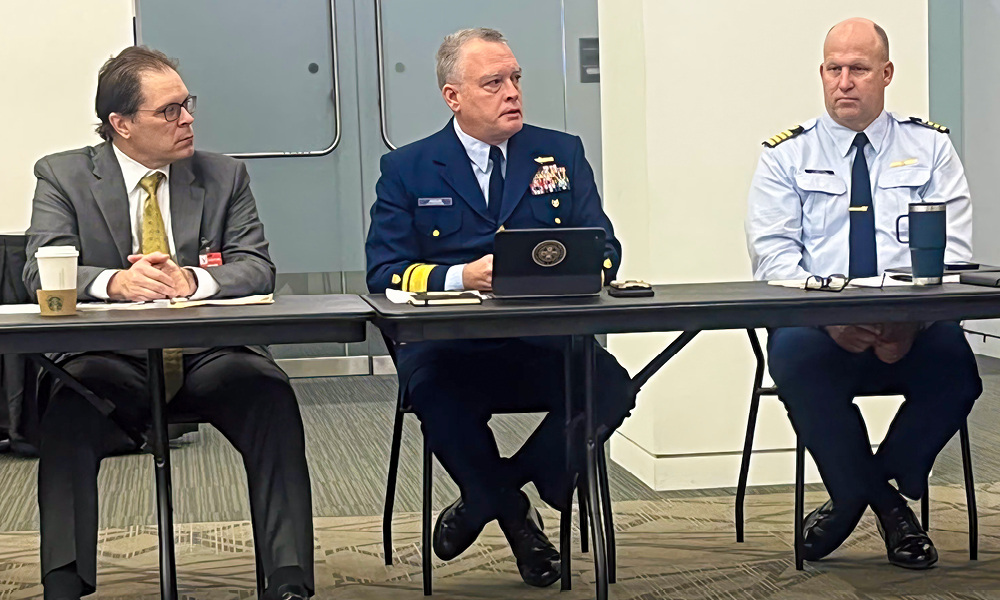
The Quality Partnership (QP) has proven to be an effective mechanism for joint industry-government action in a non-regulatory environment. It fosters transparency, improves dialogue, and leverages the expertise of both the regulator (Coast Guard) and the industry (PVA) to achieve a shared goal of enhancing safety.
The Quality Partnership … fosters transparency, improves dialogue, and leverages the expertise of both the regulator and the industry to achieve a shared goal of enhancing safety.
Combating Illegal Charters
The association reported significant progress in 2025 in targeting illegal charter operations that pose safety risks to the public. For the first time, the Coast Guard agreed to do a study on the negative impact that illegal charters have on the domestic passenger vessel industry.
Industry Education
PVA has always offered a host of information and educational training tools in the Member Resources section of the PVA website including access to the Online Learning Management System Portal. In 2025, we updated some of these tools including the Deckhand Training Manual, reconstituted the working group to look at slips, trips and falls from 2022-2024, updated the PVA Firefighting Manual, and encouraged members to engage with their local fire departments as a top priority.
Maintaining Safety On The Inland Waters
PVA advocated for important issues such as restoring critical aids to navigation and re-establishing Coast Guard small boat station staffing at some of America’s largest inland ports. Hopefully these efforts will come to fruition soon.
Economic Growth And Sustainability
In 2025, the domestic passenger vessel industry saw continued growth, with many operators’ ridership and revenue reaching pre-COVID-19 levels.
For passenger vessel operators interested in modernizing their fleets, the Capital Construction Fund (CCF) remains an essential tool for vessel operators looking to make enhancements while maintaining financial flexibility. As discussions around maritime sustainability and modernization continue, the role of the CCF in supporting industry growth will continue to expand.
I know that security is a key focus for members and there is plenty of time to discuss this topic in the upcoming months. I will add that the Safety and Security Committee has developed a PowerPoint training template that is out now that will assist members to comply with the training aspect of the new cybersecurity rule.
I would like to thank the PVA staff—John, Eric, Pete, Richard, Ed, Lee, Leslie, Sarah, Steve, and of course Tamara and Alan—for all their hard work that made my job a lot easier. Past Presidents, Patrick, Jim, and Bob, thank you for your support. Trust me when I tell you that PVA is going to be in very capable hands when the leadership is turned over to our 2026 President Andrew Sargis, Vice President John Lake and the soon to be named incoming secretary/treasurer (Ben Bernstein). I know that this is still pending a vote at MariTrends 2026 but to me, that seems to be a formality.
Thank you to the PVA Board of Directors, the PVA Associate Council and the PVA committees for all their leadership and support. The work that all of you do is truly amazing.
In closing I just would like to say what an honor and pleasure it has been to serve as your 2025 PVA president and I couldn’t be prouder to be a part of this PVA family.
Thank you again, and I wish everyone a very safe and successful 2026!
Sincerely,

Stephen Jones
PVA President, 2025

Stephen Jones is the President of the Passenger Vessel Association.