
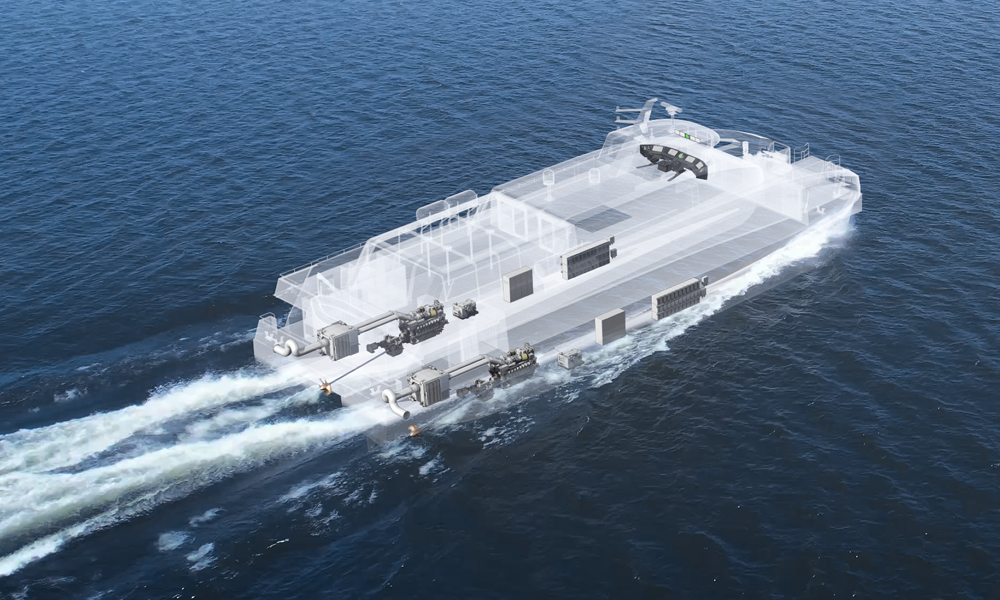
As emissions regulations continue to evolve and fuel options expand, passenger vessel operators are facing big decisions. From drop-in fuels like HVO to emerging alternatives such as methanol, understanding the specifics and trade-offs of each is key to choosing a path forward that works in real-world operations.
For years, the marine industry has been moving toward lower emissions and more sustainable operations. Now, that shift is starting to translate into real-world fuel decisions for passenger vessel operators. For decades, diesel has been the dominant marine fuel—reliable, energy-dense, and supported by global infrastructure—and it will likely continue to be for the foreseeable future based on availability and cost. But with tightening emissions regulations, changing sustainability goals, and growing pressure from regulators and customers alike, many operators are considering options for what powers their vessels.
The conversation is no longer just about compliance, it’s about strategy as fuel availability, lifecycle emissions, cost, vessel design, infrastructure readiness, and long-term viability all need to be considered. With both renewable and synthetic diesel options, plus emerging fuels such as methanol and ammonia being researched and tested, understanding the differences between these alternative fuels and what they mean in practice is essential for making informed decisions.
With both renewable and synthetic diesel options, plus emerging fuels … understanding the differences between these alternative fuels and what they mean in practice is essential for making informed decisions.
First, How Did We Get Here?
As operators well know, the shift toward alternative fuels didn’t happen overnight, it’s the result of years of tightening emissions standards that have steadily reshaped the marine landscape.
In the U.S., the Environmental Protection Agency (EPA) has progressively reduced allowable emissions from marine diesel engines, targeting pollutants like nitrogen oxides (NOx) and particulate matter (PM). Over time, these limits have driven reductions of up to 82 percent in NOx and 98 percent in PM compared to earlier engine generations. Similar global standards, including IMO Tier III, have reinforced the trend worldwide.
To meet these requirements, engine systems have become more advanced. Technologies like improved fuel injection, turbocharging, and aftertreatment systems such as selective catalytic reduction (SCR) are now common. While effective, these systems add cost, complexity, and space requirements.
At the same time, the focus has expanded beyond local emissions to include greenhouse gases. Even the cleanest diesel engines still rely on fossil fuels and reducing carbon output has become a central goal across the industry. For operators, this creates a dual challenge: meeting emissions standards today, while preparing for an even lower-carbon future.
Alternative Diesel Fuels
Today’s Drop-In Options
For many, the most practical starting point today is drop-in fuels, which are alternatives that can be used in existing diesel engines with no needed modification. These include both renewable diesel and synthetic diesel options. Because these fuels are chemically similar to conventional diesel, they can be used without changes to engines, fuel systems, or onboard storage systems, making them attractive options, as they don’t require extended downtime or complex retrofits to be introduced and result in lower emissions and virtually no particulate matter emission. Currently, the only performance drawback of these fuels is a lower energy density that could result in up to a six percent power reduction for engines using lower-pressure unit pump fuel injection as compared to high-pressure common rail fuel systems.
To create standard diesel, both the extraction of crude oil and the distillation of it during the refinery process results in a huge amount of CO2 emissions. By comparison, hydrotreated vegetable oil (HVO)—often referred to as renewable diesel—is produced from feedstocks like used cooking oil, animal fats and other waste materials.
It is created via hydrotreatment, which is the catalytic process of triglycerides to remove oxygen and break the feedstock into straight-chained hydrocarbons known as paraffins. This refining process removes impurities and creates a clean-burning fuel that behaves much like traditional diesel, but with lower particulate emissions and cleaner combustion. In practice, HVO can reduce particulate matter, carbon monoxide and hydrocarbons, often without noticeable changes in engine operation, other than the six percent power reduction.
Another renewable diesel option that is often discussed, R99 fuel, is essentially a high-purity version of renewable diesel, consisting of about 99 percent HVO and one percent conventional petroleum diesel and performing in much the same way from an operational standpoint.
Although these options offer ease-of-introduction, pricing for them can fluctuate and may carry a premium, as their current availability varies by region. However, it should be noted that municipalities that require their use are subsidizing the costs. In addition, their overall lifecycle emissions depend on how the fuel is produced.
Another option, synthetic diesels, including e-diesel fuel, are produced using processes such as electrolysis or via the Fischer-Tropsch synthesis method—which is a catalytic chemical reaction that converts a mixture of carbon monoxide and hydrogen into liquid hydrocarbons. These synthetic options can be produced from coal, natural gas, or biomass. Because these fuels are made using captured carbon and renewable energy, they offer the potential for very low lifecycle emissions.
From an operator’s perspective, the key benefit of synthetic diesel is similar to HVO in that it offers compatibility with existing engines. However, there are trade-offs, such as limited large-scale availability today, higher production costs, and dependence on a renewable energy supply.
Overall, if operators find the considerations of these drop-in fuel options to be surmountable for their specific operations, they are currently the easiest way to start reducing emissions today. They allow users to avoid major capital upgrades, maintain existing vessel configurations and reduce environmental impact immediately.
Going Beyond Diesel
What’s Next?
While drop-in fuels are useful in the near term, they don’t fully address long-term decarbonization goals, as they can run into limitations, such as feedstock scarcity and high production costs. That’s why attention is also shifting toward non-diesel alternatives. These include options such as methanol, ammonia, hydrogen, synthetic methane, and other e-fuels. Pure electric vessels are also an option in certain cases such as a point-to-point ferry service where the charging infrastructure investments can be justified. Each brings different challenges, especially when it comes to storage, energy density, and infrastructure, as most of these require significantly more onboard storage volume than diesel. For passenger vessels, where space is already at a premium, that’s a major consideration.
Among these emerging fuels, methanol is gaining attention as one of the more practical options for a wide range of marine applications. Methanol stands out because it avoids many of the challenges associated with other alternatives, as it is liquid at ambient conditions, does not require cryogenic storage, and can be handled using modified versions of existing fuel systems. For operators, this translates to fewer design hurdles compared to other options such as hydrogen or liquified natural gas (LNG).
While methanol does require more storage volume than diesel, it remains manageable within many vessel designs. It offers flexibility across different vessel types and is particularly well-suited for coastal and short-sea route vessels including ferries, tour boats, and other operations with predictable fueling access. Another advantage is familiarity, as pure methanol is already produced and transported globally, and many ports have experience handling it for other industries. The market has also been considering a dual diesel/methanol technology, but this requires vessels to incorporate separate tanks for each fuel and all the aftertreatment technologies to meet EPA Tier 4 or IMO III regulations, where machinery space is already tight.
Like other fuels, methanol’s true environmental benefits depend on how it’s produced. The conventional (grey) methanol, which is produced from fossil fuels, offers limited carbon reduction and a worse emissions profile than standard diesel, while green methanol, produced from renewable energy, offers significant potential. If production scales, green methanol is expected to play a larger role in marine decarbonization.
While methanol is gaining traction, other fuels are still part of the long-term conversation. For example, ammonia offers the potential for zero carbon emissions at the point of use, making it attractive for deep-sea shipping. However, for passenger vessels, toxicity is a major concern with ammonia use, and its storage systems are complex. As a result, ammonia is generally viewed as a longer-term option, better suited to large, ocean-going vessels.
Hydrogen is another option that has strong environmental potential but presents practical challenges as it is very low energy density by volume, requires high-pressure or cryogenic storage, and there is currently limited infrastructure for its widespread use. This makes it more viable for niche or short-range applications rather than widespread passenger use, at least for now.
Other synthetic fuels can reduce lifecycle emissions and may benefit from existing infrastructure. However, as of today, they can be costly to produce, and their availability is still developing.
Key Considerations For Passenger Vessel Operators
With numerous options becoming available and potentially more on the way, choosing a path forward can feel uncertain. In practice, most decisions come down to a few key factors:
Vessel Type And Route
Short, predictable routes may allow for more flexibility in fuel choice, while longer routes may still favor higher energy density fuels.
Space And Design Constraints
Passenger vessels often have limited room for additional fuel storage or new systems. This can rule out certain options quickly.
Fuel Availability
Not all fuels are available in all regions. Local infrastructure and supply chains will heavily influence what’s feasible.
Cost And Operational Impact
Fuel price is only part of the equation. Operators must also consider things such as installation costs, maintenance requirements, training and safety procedures
Future Flexibility
Given how quickly the landscape is evolving, avoiding lock-in is important. Solutions that allow for adaptation over time may offer a strategic advantage.
Conclusion
There’s no single fuel that solves every challenge facing the marine industry today, especially when reliability and operational flexibility are non-negotiable. But in the near term, drop-in fuels will offer a practical way to reduce emissions without major changes to vessels or infrastructure, allowing operators to make progress now while keeping options open for the future.
Drop-in fuels will offer a practical way to reduce emissions … allowing operators to make progress now while keeping options open for the future.
Looking further ahead, fuels like methanol are gaining momentum because they strike a workable balance between emissions reduction, storage requirements, and operational feasibility. Other options, such as ammonia and hydrogen, may play a role over time, but they come with added complexity that will take longer to address, particularly for passenger-focused operations.
For most, the path forward will likely be incremental. That means starting with solutions that fit today’s vessels and routes, while planning for flexibility as fuel availability, regulations, and technology continue to evolve. The best approach is to understand the trade-offs, make informed decisions based on your operation, and stay adaptable as the fuel landscape continues to shift.

Tim Peters works in Commercial Marine Sales & Application Engineering at Rolls-Royce Solutions America. Since joining the company in 2011, he has supported commercial and recreational marine markets, transitioning to a North American sales role in 2018. Previously, he served as assistant director of the University of Michigan Marine Hydrodynamics Laboratories, overseeing hydrodynamic testing across defense, offshore, and commercial marine applications.