When assembling the current version of the Flagship SMS Program, the focus was on the requirements to make the program and system work: getting the twelve chapters right, getting the definitions right, getting the pathway from notice of intent to audit right. As the saying goes, however, good ideas do not wait for the right moment. While heads down on the requirements, I kept running into areas that I knew would help members implement Flagship and get more value out of it over time, ideas that were beyond the immediate scope of what was being built at that moment. Rather than lose focus on the task at hand, I started a list. Every time one of those ideas surfaced, whether it came from a conversation with a PVA member, with PVA staff, or something I noticed while reviewing a gap analysis, I wrote it down and kept moving.
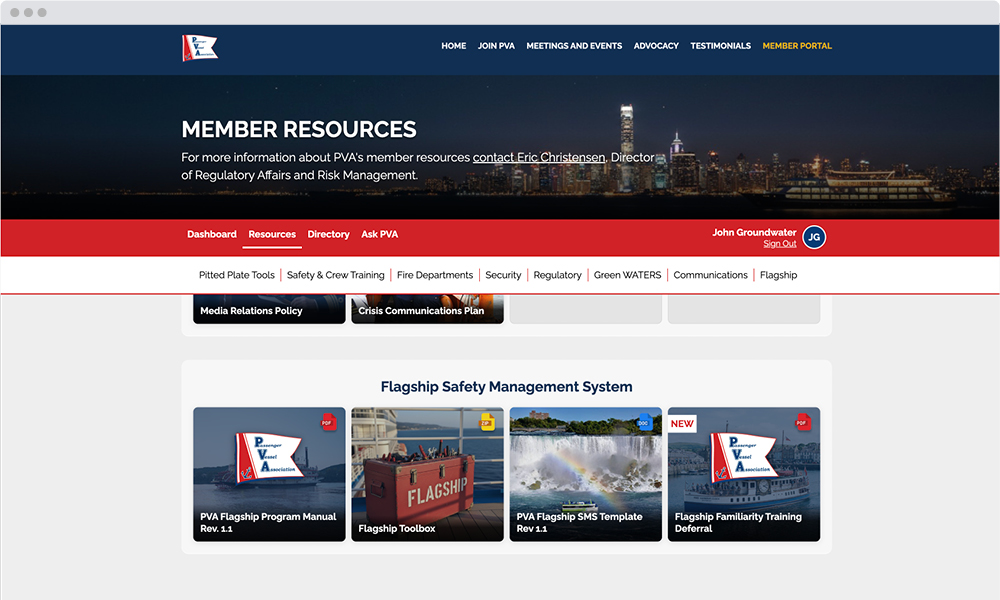
That list has become my worklist for what is now taking shape in Member Resources on the PVA Member Portal, a growing area meant to sit alongside the core program and make it easier to use. Templates, forms, and procedures will live together there in a dedicated area called the Toolbox. Some of these tools already exist and are in members’ hands today. Other resources and tools are still on my worklist. I want to walk through both in this article, because participating in Flagship and getting the most out of it is easier when you know what is already available and what is coming.
The Sms Manual Template
The starting point for most members is the Flagship SMS Manual Template, which you will find in Flagship Member Resources. Building an SMS manual from a blank page is a significant undertaking, and PVA did not want every member to have to do that on their own. The template we provide today traces back to foundational work by Mike McElroy and Wendella Cruises & Tours, who developed an early manual structure that PVA adapted into the template now used across the program. Their work made Flagship implementation faster and more consistent for every member who will come after them.
The Flagship Program Manual
Alongside the SMS manual template, we maintain a full requirements document, the Flagship Program Manual, that spells out everything required to participate in and remain compliant with the program. I use this document constantly when I review where a member stands, and I encourage others to use it the same way internally. It turns Flagship from an abstract goal into a checklist you can work through section by section, whether you are just starting a gap analysis or preparing for your first Flagship Audit.
Policy Notices To Keep You Current
Flagship is a living program, and requirements shift as training offerings and partner organizations evolve. When something changes that affects participants broadly, PVA issues a policy notice, so nobody is left guessing. A recent example is our notice deferring Flagship Familiarity Training until an approved training offering is available. In the meantime, every other training and experience requirement stays in effect, and I encourage participating companies to set an internal policy now, so crews are ready to complete that training as soon as it is posted. Watching for these notices, and reading them carefully, is one of the simplest ways to stay on track.
Flagship Familiarity Training
Speaking of this training, I want to spend a moment on this one specifically. Flagship Familiarity Training is currently paused under FPN-2026-01 until approved by PVA. (It’s nearly done!) Nothing about this deferral changes what is expected of participating companies in the meantime. Per SMS Requirements 6.3 and 6.4, each company should establish its own internal policy for how Flagship Familiarity Training will be handled once it becomes available and be ready to put that policy into action as soon as an approved offering is published.
Since the course itself is nearly done, I can give you a preview of what it covers. It opens by laying out who actually needs it: your company decides how to build general SMS familiarity across the workforce, but completion of the course itself is a named requirement for designated persons and for internal and external Flagship auditors. From there it walks through what Flagship is and how it differs from ISM, TSMS, and ISO QMS, things like the option to use internal or external auditors, the attestation-based model in place of a document of compliance or safety management certificate, and the protocol for a major nonconformity. It covers who is who in the program, the company, the designated person, the master, recognized flagship organizations (RFOs), and Flagship Training Service Providers (FTSPs), walks through all twelve functional elements of the SMS, and closes with the continual improvement loop that ties reporting, root cause analysis, corrective action, and audits back together. Once an approved offering is ready, I will post it in Member Resources and lift the deferral in the same notice.
Issues, Lessons Learned, and Recommendations
Program requirement 7.3 directs PVA to maintain a running list of issues, lessons learned, and recommendations for improving the Flagship Program, submitted by members and associate members, along with how each one was resolved. The SMS Manual Template already builds the habit on the member side, chapter 9 calls for issues, lessons learned, best practices, and recommendations to be submitted to PVA as part of your normal reporting. What I am still building is the resource on our end, a maintained, searchable library where that submitted knowledge actually lives and gets shared back out. I see this as one of the most valuable resources we can build, because it captures the kind of practical knowledge that usually only lives in one member’s head. Down the road, I want this same mechanism to support a near miss database, so members can learn from close calls across the fleet, not just their own. If you have run into something worth flagging, whether it is a gap in the program or a fix that worked well, send it my way. That is exactly what this self-imposed requirement is for.
Designation And Organization Templates
A recurring early question from participating companies is how to formally designate a designated person and internal auditors, and how to show that structure on paper. The good news is that part of this one is already in your hands. The SMS Manual Template includes an editable company organizational chart and a job description template in chapter 3, along with the policy language for designated person designation in chapter 4. What is still on my worklist is a standalone designation letter template, the kind of document chapter 4 references posting alongside your org chart and safety policy, plus a matching template for designating internal auditors. Both will be added to the Toolbox once they are ready, to save you from drafting that documentation from scratch and to make sure the designations hold up cleanly when an auditor or the U.S. Coast Guard would like to review them.
Sample Procedures And Plans
Requirement 7.1 asks each company to establish the procedures, plans, and instructions needed to direct the safe operation of its vessels and protect the marine environment, in compliance with applicable U.S. law and, for international voyages, applicable international conventions. The Manual Template gets you partway there today. Chapters 7 and 8 already lay out the full checklist of vessel operating procedures and emergency procedures your program needs to address, from anchoring and fueling to fire and man overboard response, so you know exactly what to cover. What those chapters do not yet include is the sample procedure text itself for each item on that list. Writing that content from a blank page is a heavy lift for any company, so I am developing sample procedures and plans to add to the Toolbox alongside the checklist, a starting point to adapt rather than an empty page to fill. My goal is for these samples to complement and strengthen what you are already building, not to hand you a one-size-fits-all document that ignores how your operation actually runs.
Direct Support From Pva Staff
Beyond the documents and the partner organizations, I want members to know that direct support is part of what’s here for you too, alongside everything else in Member Resources. I try to keep a regular check-in cadence with participating companies, and I am glad to schedule an onsite visit ahead of an audit if that would help. I’m here to help members in their Flagship journey. That kind of direct access is something PVA can offer that larger regulatory processes often cannot, and it is one of the things I am proudest of about this program.
Putting It Together
None of these resources are meant to replace the work participating companies must do. Flagship still asks for quite a bit of work, and it should, because recognition only means something if it is earned. What PVA can do is make sure nobody has to build that work from scratch or figure it out alone. The manual template, the requirements document, our approved audit and training providers, our policy notices, the growing library of lessons learned, our designation and org chart templates, and our sample procedures and plans will all live together in Member Resources, with the templates, forms, and procedures collected in the Toolbox, backed up by direct staff support along the way.
If you are considering or currently participating in Flagship SMS and are not sure which resource to tap into, reach out to me directly at lboone@passengervessel.com.

Lee Boone is the PVA Senior Regulatory and Programs Advisor