
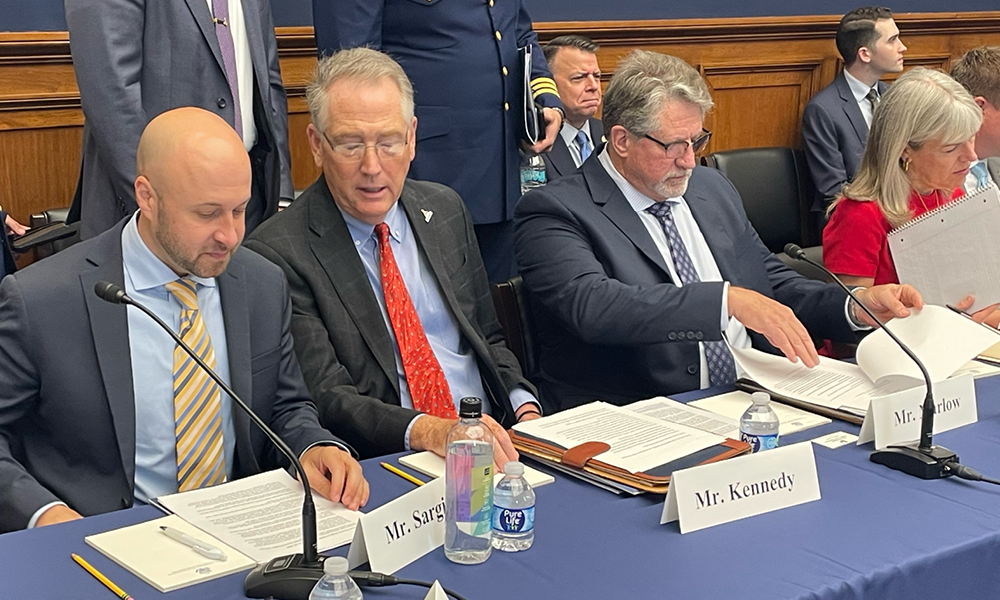
On July 21, I sat behind a nameplate that read “Andrew Sargis, Passenger Vessel Association” in room 2167 of the Rayburn House Office Building. Chairman Mike Ezell had called the House Transportation and Infrastructure Committee’s Subcommittee on Coast Guard and Maritime Transportation into session for a roundtable titled “Intersecting Courses: Maritime Safety Regulation and Technology.” I was there to speak for 600 PVA members and the roughly 200 million passengers we carry every year, and to make sure the people writing U.S. Coast Guard policy heard directly from the operators who live with the results of that policy every day. In addition to representing PVA, I also found myself the only actual operator and businessman at the table which was otherwise filled with politicians or trade organization directors.
This was not a hearing that landed on the calendar by accident. In April, nearly 40 PVA members walked the halls of Congress for our annual fly-in, and in every single meeting we carried the same ask: hold a hearing or roundtable on how the Coast Guard’s mission realignment under Force Design 2028 is affecting the marine safety mission. We had a precedent in mind. In 2007, Congressman James Oberstar held a similar oversight hearing after industry raised the alarm that experienced safety inspectors were being pulled into other missions, and that hearing reshaped how the Coast Guard staffs and prioritizes marine safety to this day. Three months after our fly-in, the subcommittee scheduled this roundtable. Watching an ask that we made as an association turn into an actual roundtable, with an actual witness table, and PVA’s name on it, is not something we take for granted.
In every single meeting we carried the same ask: hold a hearing or roundtable on how the Coast Guard’s mission realignment under Force Design 2028 is affecting the marine safety mission.
My opening statement covered four asks. Keep the Coast Guard’s marine safety mission fully resourced even as Force Design 2028 pulls attention and billets toward the border and military readiness. Protect the National Maritime Center from shutting down every time Congress cannot pass a budget on time. Get a real assessment of aids to navigation on the Western Rivers, where five aging buoy tenders cover roughly 2,200 navigable river miles across eleven states. And give the Coast Guard the enforcement teeth it needs against deadly illegal charter operators.
That last one is personal to me. I run boats on the Chicago River and Lake Michigan, and illegal operators have endangered our waterways for years. When Congresswoman Hillary Scholten, whose district includes Grand Haven, asked the panel how search and rescue closures were hitting our industry, I did not need to check my notes. I told her our Great Lakes members are already leaning on social media groups of good Samaritans and local police to fill gaps the Coast Guard used to cover. I told her the illegal charter problem gets worse every time enforcement disappears, because the bad guys get bolder. That is not a talking point. That is what our members in Chicago, Pittsburgh, and Mackinaw tell me directly.
The exchange I am proudest of came near the end of the roundtable, when Charian Ezell asked directly how operators who follow the law differentiate themselves from the ones cutting corners. I laid it out plainly. Our crews are trained. Our boats are inspected. Most passengers have no idea any of that matters until something goes wrong. Illegal operators skip the licensing, skip the insurance, skip the safety gear, and some of them are running crimes ancillary to the illegal charter itself: money laundering, narcotics, worse. I told the committee the fines these operators face get treated as a cost of doing business, and that has to change.
The response told me the message landed. Rear Admiral Compher backed it up from the Coast Guard’s side, calling illegal charters a safety issue and not just a fairness issue, and laying out how investigators, boarding teams, and the Department of Justice are starting to coordinate on it. When the person across the table and the person next to you are describing the same problem in the same words, you know you have put your finger on something real.
I walked out of Rayburn feeling good about where PVA stands with this committee. But when Chairman Ezell and his collea gues picture domestic maritime safety, I want them picturing our members’ boats and our members’ crews, not just an organizational chart at Coast Guard headquarters.
I believe that happened.
The GAO study on illegal charters that PVA pushed to get authorized is still moving through the pipeline. When it lands, we intend to make sure it does not sit on a shelf. Testifying was one afternoon. Turning that afternoon, and the fly-in ask that led to it, into real enforcement authority and real resources for the Coast Guard’s safety mission is the work still ahead of us, and I plan to keep showing up in that room until it gets done.
We were reminded of the grave importance of this task recently when an illegal charter in New York capsized leading to the death of a woman and child. The scourge of these bad actors and the tools to fight them are of the utmost importance to the Coast Guard’s Safety and Prevention Missions, and PVA will never stop advocating for these missions.
Sincerely,
Andrew Sargis
PVA President, 2026

Andrew Sargis, PVA President 2026