

On most passenger vessels, safety isn’t an abstract value—it’s a daily operating condition. It shows up in the morning brief, in the engineer’s log, in a deckhand’s judgment call when weather shifts, and in the calm competence of a crew responding to an unexpected alarm. And yet, the way many organizations manage safety still leans heavily on static artifacts: binders, spreadsheets, disconnected forms, and checklists that are technically complete, but operationally hard to keep current.
That gap matters. Not because people don’t care—operators care deeply—but because passenger vessel operations are complex systems. They’re shaped by changing routes, seasonal staffing, maintenance realities, evolving equipment, vendor dependencies, and the steady drumbeat of regulatory and client expectations. In that environment, safety documentation can’t just be stored; it needs to be alive.
This article offers an editorially grounded, operator-first look at how passenger vessel companies can move from paper compliance toward a living safety system—one that is easier to maintain, easier to audit, and most importantly, easier to use on the days when it counts.
The Modern Reality
Safety Is a System, not a File Cabinet
Many of the industry’s requirements already point toward systems thinking. Safety management approaches—whether formalized under international frameworks or implemented through domestic programs—emphasize consistent policies, procedures, training, and verification of compliance. Even outside passenger vessels, U.S. Coast Guard safety management frameworks describe the purpose of a management system as establishing policies, procedures, and required documentation to ensure continuous compliance and alignment across the organization.
On the passenger vessel side, operators navigate a dense ecosystem: inspection regimes, equipment and operational rules, environmental expectations, and customer-facing obligations. The Coast Guard’s passenger vessel compliance resources are a reminder that these requirements can differ significantly by vessel type, route, and voyage profile.
The practical takeaway: you can’t “solve” safety with a one-time documentation push. When operations change—which they always do—your safety program needs to change with them.
Where Good Programs Struggle
Four Failure Modes
Across regulated industries, most safety programs don’t fail because they’re poorly intentioned. They struggle because of predictable operational pressures:
The practical takeaway: you can’t “solve” safety with a one-time documentation push. When operations change—which they always do—your safety program needs to change with them.
1. Documentation Drift
Procedures and forms get created during an audit cycle, then slowly stop matching reality. The crew adapts to the real world; the binder doesn’t.
2. Invisible Risk
Hazards get discussed informally—“watch that dock,” “that crossing gets sporty on a flood tide”—but the organization lacks a consistent way to capture, prioritize, and learn from those insights.
3. Change Without Choreography
Equipment is replaced, routes are modified, staffing models shift, vendors change—often with good reasons. But the organization doesn’t consistently run those changes through a structured review that asks, “What new risks did we just create?”
4. Audit As Theater
Teams scramble to assemble proof: training records, maintenance history, drill logs, corrective actions. The evidence exists, but it’s scattered—and the time spent “proving” safety competes with doing the work.
None of these are moral failures; they’re workflow problems.
The Living System Concept
Make Safety Easier to Do Than to Skip
A living safety system is not “more paperwork.” It’s the opposite: a set of workflows that make safe operations the path of least resistance.
Think of it like this: the best safety programs aren’t built around documents. They’re built around decisions.
- What do we do today, with this vessel, this crew, this weather, this passenger load?
- What’s changed since last week?
- What needs attention before it becomes an incident?
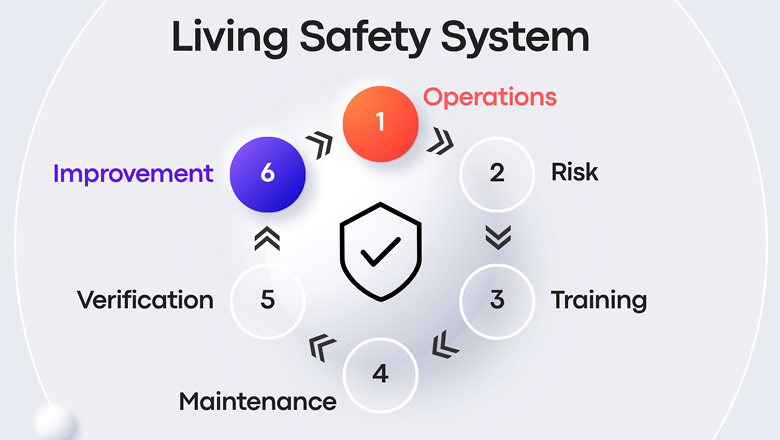
A living system connects the operational dots: maintenance, training, drills, inspections, risk assessments, corrective actions, and change management—so they reinforce each other instead of living in silos.
A Practical Framework
Five Building Blocks That Reinforce Each Other
Here’s a field-tested structure that scales from small fleets to multi-port operators.
1. Clear Standards That Match The Way You Actually Operate
Start by defining the minimum non-negotiables: operational policies, emergency procedures, maintenance routines, and training expectations. The goal is not to write a novel; it’s to produce standards that are:
- Specific enough that a new crew member can follow them
- Flexible enough to reflect real operating conditions
- Owned by operations (not just “maintained by the office”)
This is where many programs overreach. If your manual requires perfection, your team will create workarounds. If it supports good judgment, they’ll use it.
2. A Simple Risk Model People Will Actually Use
PVA and the U.S. Coast Guard have long emphasized risk-based thinking as a practical way to improve passenger vessel safety. The challenge is making risk assessment routine rather than ceremonial.
A usable model typically has:
- A small number of hazard categories
- A consistent severity/likelihood scale
- A short list of standard controls
- A way to record local knowledge (route quirks, seasonal patterns, recurring near-misses)
The win isn’t the score. The win is the conversation becoming consistent, capturable, and comparable over time.
3. Management Of Change As A Routine Habit, Not An Emergency Measure
In the marine industry, management of change (MOC) is widely recognized as a structured way to evaluate modifications that could affect safety, environmental performance, or operational effectiveness.
For passenger vessels, change can be as ordinary as:
- Swapping a fuel system component
- Updating passenger flow or boarding procedures
- Onboarding seasonal crew
- Modifying routes, schedules, or dock arrangements
- Adopting new electronic systems or vendors
A lightweight MOC workflow asks:
- What’s changing?
- What hazards could this introduce?
- What procedures/training/maintenance should be updated?
- Who approves?
- What evidence closes it out?
When MOC becomes normal, incidents become rarer—and audits become easier because you can show your work.
4. Evidence That Is Generated As A Byproduct Of Operations
The best compliance evidence is the evidence you don’t have to “compile.” The Coast Guard’s unwritten rule is simple: if it isn’t documented, it didn’t happen.
This is where many operators benefit from shifting away from forms as files toward forms as events. Instead of storing documents in a maze of folders, treat key actions as structured records:
- Drills completed
- Maintenance performed
- Inspections logged
- Corrective actions closed
- Training validated
When evidence is captured in the flow of work, you reduce administrative drag—and you build audit readiness continuously, not seasonally.
5. Feedback Loops That Turn Experience Into Improvement
A living system learns. That means near-misses and minor failures aren’t treated as nuisances—they’re treated as data.
Two small practices create outsized returns:
- Short after-action reviews after drills, incidents, and operational surprises
- A visible corrective action pipeline that shows what’s open, what’s overdue, and what’s working
This is where culture and systems meet. The system makes it easier to speak up; leadership makes it safe to do so.
New propulsion? New hazards and training needs. New reporting expectations? New data flows. New vendors? New dependencies. A living safety system doesn’t just help you comply—it helps you adapt.
What This Looks Like In Practice
The Safety Program Maturity Ladder
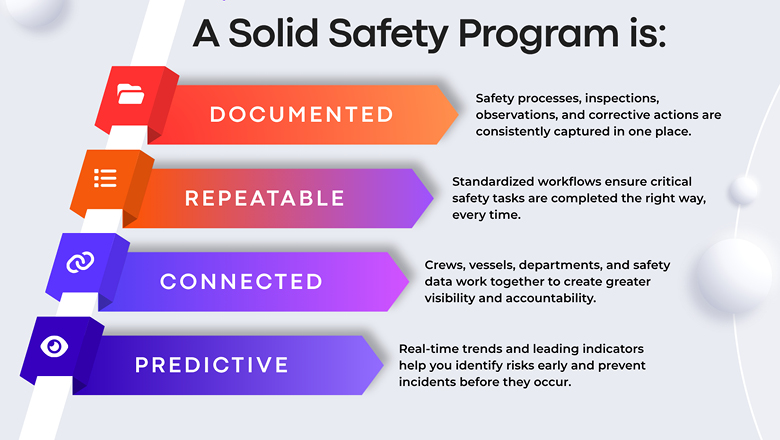
Most operators don’t jump from binders to brilliance. They climb a ladder:
Level 1: Documented
Policies exist. Records exist. Knowledge lives in people’s heads.
Level 2: Repeatable
Routine workflows exist: drills, maintenance, training. Evidence is still scattered.
Level 3: Connected
Risk, maintenance, training, corrective actions, and change management talk to each other.
Level 4: Predictive
Trends are visible early: recurring deficiencies, training gaps, equipment that drives downtime, routes with consistent risk profiles.
The goal is not to digitize everything. The goal is to connect the right things, so your program behaves like a system.
Why This Matters Now
Technology and Environmental Expectations Are Rising Together
Passenger vessel operators are facing a period where technology, propulsion changes, and environmental expectations are accelerating. PVA’s Green WATERS program underscores that sustainability practices are evolving and meant to be practical, operator-specific, and non-disruptive.
As new systems and expectations enter operations, change management and structured evidence become even more important. New propulsion? New hazards and training needs. New reporting expectations? New data flows. New vendors? New dependencies.
A living safety system doesn’t just help you comply—it helps you adapt.
Closing Thought
Make The Safe Way The Easy Way
In passenger vessel operations, the most resilient safety cultures share a common trait: they reduce friction for doing the right thing. They make expectations clear, workflows simple, and learning routine. They treat compliance evidence as operational exhaust—something produced naturally when the system is designed well.
A living safety system doesn’t replace seamanship or judgment. It supports them—by keeping the organization aligned, current, and ready for the moments that matter most.
Founder, President, and Partner, Veris Global LLC
Keith Seilhan is founder, president, and partner of Veris Global LLC, a software as a service and consulting firm. Previously, Seilhan was chief operating officer for Stone Energy. Prior to that, het filled various senior operations and engineering leadership roles for BP and Amoco. His industry experience focuses on working with the development, start-up, and operation of large, technically challenging deep water and onshore assets. Seilhan has leadership experience in operations, engineering, and major projects with focus on commercial, operations, risk management, and continuous improvement activities. He is an alumnus of the Stanford Executive program and the MIT Operations Academy.