
As we just observed National Maritime Day on May 22, I’d like to take this opportunity to celebrate our U.S. merchant mariners and the broader maritime workforce. Since 1933, when Congress designated May 22 as the day to commemorate the S.S. Savannah’s 1819 transatlantic voyage—the first steamship ever to make the crossing—we have honored the brave, hardworking, and dedicated mariners who sail the high seas in service of their country. Over time, the observance has expanded to include the wider maritime workforce, both on and offshore, in recognition of their essential roles in ensuring a well-functioning economy and our national security. The U.S. maritime sector is responsible for the safe transport of people and billions of tons of cargo annually across our U.S. waterways, touching virtually every aspect of American life, from the clothes we wear, to the cars and trucks we drive, to the food we eat, to the oil and natural gas heating and cooling our homes. It supports millions of jobs, facilitates trade, moves people and goods, and provides a safe, secure, cost-effective, and energy-efficient transportation alternative for work, travel and tourism. The workforce enabling all this activity—including the hardworking members of the passenger vessel industry—is vital to American prosperity.
Today, we have a renewed focus on maritime workforce driven by Executive Order 14269, “Restoring America’s Maritime Dominance” and implementation of the administration’s 2026 Maritime Action Plan. National Maritime Day gives us a chance to describe some of the efforts underway to advance the recruitment, retention, and well-being of the existing and future workforce within the U.S. Marine Transportation System (MTS). The health and welfare of the maritime workforce is certainly a priority for the interagency U.S. Committee on the Marine Transportation System (CMTS). The CMTS, where I serve as director, brings together more than 35 federal agencies and offices with maritime responsibilities to ensure that the MTS continues to meet the present and future needs of our nation. We have an interagency team specifically for mariners and the maritime workforce, which focuses on workforce quality of life and mariner mental health, career advancement and professional development in MTS fields, and stakeholder outreach for recruitment, retention, and career opportunities.
In the spirit of National Maritime Day, two important CMTS workforce objectives are to bring attention to the vital importance of the U.S. merchant marine for national security, safety, and prosperity, and to facilitate the transition of active-duty service members into the U.S. maritime industry. Many agencies—all likely familiar to Foghorn readers—are working together and individually to accomplish these objectives, including the Department of Transportation’s Maritime Administration, the U.S. Coast Guard, Military Sealift Command, and the National Oceanic and Atmospheric Administration. For example, we have a fun and exciting opportunity coming up in July at the American School Counselors Association conference in New Orleans where we will co-locate examples of maritime career opportunities at many levels. Last year, the American Maritime Officers Union coordinated a first-ever ‘Mariners Row’ at the 2025 ASCA Conference in California. It was a huge success, made possible by sponsorships and participation by representatives of AMO, MARAD, the STAR Center, the Seafarers International Union, MSC, the unions, federal and state maritime academies and universities, and many private sector companies and NGOs.
Fast forward to 2026, and we are planning another strong Mariners Row where 6000+ school counselors from across the country who interact with K-12 students daily will descend on New Orleans. Reports from last year underscore that most counselors do not know much about maritime, but when they hear about the wages and job opportunities available at all levels of ability and education, many eagerly want to know more so they can share with their students. They also may have really enjoyed the Mariners Row social hour… The CMTS is helping with Mariners Row to support all aspects of the MTS in our shared effort to increase recruitment and retention for a well-functioning domestic and international freight and logistics supply chain. Side note: we do need passenger vessel representatives at ASCA, so if there are any PVA members interested, please contact me to find out if there is still space available to educate the counselors on vessel and supplier employment options!
Reports from last year underscore that most counselors do not know much about maritime, but when they hear about the wages and job opportunities available at all levels of ability and education, many eagerly want to know more so they can share with their students.
Another federal initiative is Military to Mariner, or M2M. As you are probably well aware, crewing shortages have affected every sector of the maritime industry. The International Chamber of Shipping predicts a global crewing shortfall of approximately 90,000 seafarers by 2026. In the maritime industry, veterans come to the table with a wealth of experience beyond the average applicant. There are myriad reasons to hire veteran mariners, not least of which is their strong work ethic, proven leadership and leadership readiness, strong performance under pressure, adaptability, and experience working in diverse teams and organizations. They are generally self-starters, and often subject matter experts depending on their particular rating, be they machinery technicians, boatswains’ mates, or yeomen. Many of these skills are transferable to the merchant marine and passenger vessel operations.
There are myriad reasons to hire veteran mariners, not least of which is their strong work ethic, proven leadership and leadership readiness, strong performance under pressure, adaptability, and experience working in diverse teams and organizations. Many of these skills are transferable to the merchant marine and passenger vessel operations.
The M2M initiative seeks to help alleviate workforce shortages by making it easier for active duty servicemembers and veterans to transfer their skills and experience to the maritime industry. The CMTS has worked on M2M since 2014, hosting roundtables, workshops, and webinars. In 2019 the president signed Executive Order (EO) 13860, Supporting the Transition of Active Duty Servicemembers and Military Veterans Into the Merchant Marine. This EO brought attention to the importance of the U.S. Merchant Marine and the need to facilitate the transition of active-duty service members more easily into the U.S. maritime industry. The EO specifically tasks the CMTS with “pursu[ing] innovative ways to support merchant mariner credentialing.” Since then, we have undertaken to advance the aims put forth in the EO through mariner outreach and collaboration with partner agencies and organizations, such as MARAD, the Veterans Affairs Administration, MilitarytoMaritime.org, and the Maritime Institute of Technology and Graduate Studies, or MITAGS. These programs differ in where and how they seek to employ mariners. The MARAD initiative is specifically geared toward building the ranks of the Merchant Marine, while other initiatives are broader in their scope and seek to bolster the larger maritime workforce.
The U.S. Navy and Coast Guard both have Credentialing Opportunities On-Line (COOL) programs. The purpose of COOL is to assist service members in obtaining credentials while in the service. The programs differ slightly in their steps, but the process is largely the same. Sailors and Coasties find the credential they wish to pursue, complete the appropriate funding process, schedule and take the credentialing exam, and report their results to the appropriate authority. COOL is primarily intended for active-duty service members, but there are resources for employers seeking to hire qualified veteran mariners, including explanations of how service members obtain their ratings (career specialty), school locations, training time, qualifications, opportunities, and interests, and how the ratings are related to various civilian career areas. These resources are an invaluable tool for employers looking to hire veterans and understand how their experience can translate to the civilian maritime industry.
There are additional programs available to active-duty service members and veterans, including MilGears, SkillBridge and the Veterans Employment Outreach Program (VEOP). These programs often work in conjunction with the COOL programs. The MilGears program offers a military to mariner component. MilGears allows service members to determine the credentials for which they may be well suited by uploading the appropriate documents to the MilGears portal to identify gaps in training or experience that may hinder the service member in their pursuit of the credentials.
It should be noted that while MilGears helps service members pursue merchant mariner credentials, it is the Coast Guard’s National Maritime Center that has final say as to the service member’s ability to obtain the credential. The Coast Guard is working to develop NAVITA (Latin for ‘mariner’), a web-based mariner credentialing portal which will allow merchant mariner applicants and others to apply for, track status of, and otherwise manage their merchant mariner credentials and medical certificates. With this new capability, the Coast Guard aims to provide maritime industry customers with a modern application system that greatly improves efficiency, consistency, and customer service. Commercial software programs do exist to help mariners navigate the credentialing process; one example is MM-SEAS, which states that it offers step-by-step licensing guidance and support for electronic sea service form generation.
SkillBridge is a military offering that assists active-duty military the opportunity to gain real world experience in 180-day apprenticeships prior to separation. The program offers prospective employers the opportunity to train and hire excellent candidates. All service members separating or retiring from service also have access to the Transition Assistance Program, which assists service members transition from military to civilian life. The program is about a week long and features everything from explanations of veterans’ benefits to a Department of Labor (DOL) employment workshop. DOL also runs VEOP, which connects employers with veterans, active-duty service members, and military spouses.
One thing I am very excited about is CMTS agency participation in the implementation of the Maritime Action Plan (MAP). Along with shipbuilding and goals to improve the Maritime Industrial Base, the MAP devotes an entire section to reforming workforce education and training, placing an emphasis on quality of life, housing, and affordability. Pillar 2 actions include modernizing the U.S. Merchant Marine Academy and increasing support for our state maritime academies, expanding apprenticeships, talent pipelines and regional training partnerships, and investing in effective workforce development programs for retention, surge hiring and long‑term skill demand. The MAP specifically notes M2M as a way to increase the number of credentialed mariners, including by maximizing credit for military training and sea service, expanding fee exemptions, formalizing equivalency guidance and approving reciprocity for military courses to meet training requirements. The MAP also directs outreach and investment to diversify workforce development resources, including through K-12, community college, and vocational engagement.
To close, crewing shortages put a strain on the maritime industry, but utilizing M2M and similar programs may help to alleviate some of that strain. By engaging with the federal programs noted above, employers may find qualified candidates who can transition their military sea service experience to Coast Guard-recognized merchant mariner licenses. On this National Maritime Day, let’s celebrate by recognizing the critical role of mariners to our economic stability and national defense. And going forward, let’s work together to cultivate, expand, and retain both credentialed mariners and a skilled maritime workforce in order to grow the economy and protect our shores.
Any references to non-Federal entities herein are for illustrative and educational purposes only and should not be construed as an endorsement of, or preference for, any product, service, or enterprise by the U.S. Committee on the Marine Transportation System, Maritime Administration, U.S. Department of Transportation, or U.S. Government.
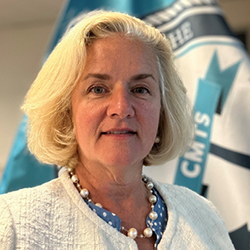
Ashley Chappell came from NOAA to serve as executive director of the U.S. Committee on the Marine Transportation System. She started out as a cartographer, then migrated from nautical charts to policy, strategic planning, and budget formulation in support of safe and efficient marine transportation. In her last role at NOAA, she led the Integrated Ocean and Coastal Mapping program and co-chaired the Interagency Working Group on Ocean and Coastal Mapping. This background in interagency and stakeholder relationship-building is key to her work on the CMTS.