
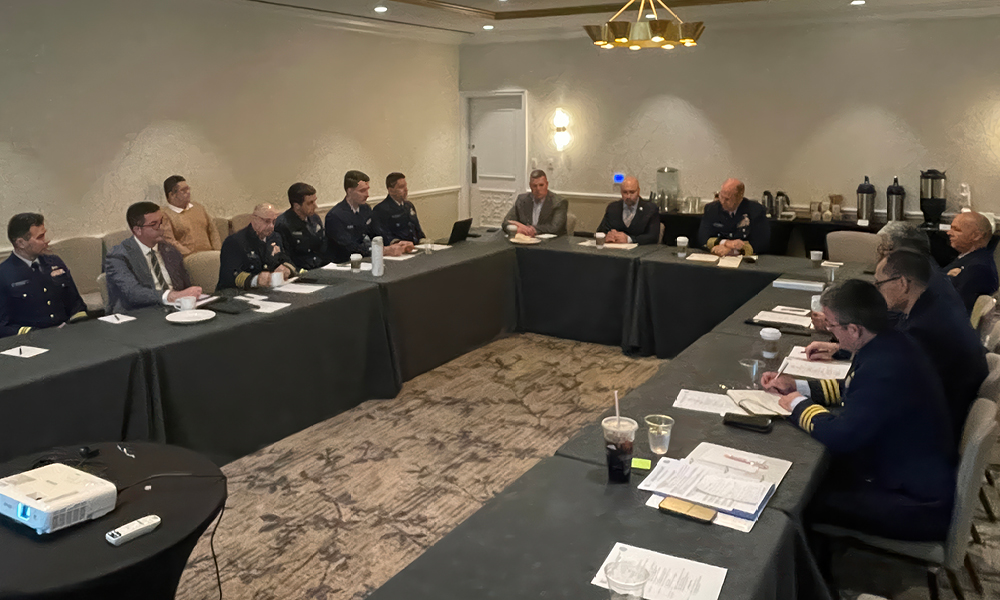
On May 7, 2026, the PVA/U.S. Coast Guard Quality Partnership (QP) met in person in Alexandria, Va. In the weeks leading up to the meeting there was budgetary uncertainty that threatened to derail the spring meeting of PVA and Coast Guard senior leadership.
Established in 1996 under the Coast Guard’s Prevention Through People initiative, specifically the tenet “Honor the Mariner,” the QP is a long-standing forum whereby senior PVA and Coast Guard leadership meet twice a year to discuss issues of mutual concern and seek non-regulatory solutions. In his opening remarks supporting the benefits of the partnership, Rear Admiral (Select) Rober Compher, the incoming assistant commandant for Prevention Policy and no stranger to working with PVA, stated that PVA was “the eyes and ears of the industry.” PVA President Andrew Sargis reinforced PVA’s commitment to maintaining the relationship by highlighting PVA’s efforts to educate members of Congress and their staff on the importance of the Coast Guard Marine Safety mission during the Congressional Fly-In held just two weeks earlier in April.
In his opening remarks supporting the benefits of the partnership, Rear Admiral (Select) Rober Compher, the incoming assistant commandant for Prevention Policy and no stranger to working with PVA, stated that PVA was “the eyes and ears of the industry.”
Shutdown Recovery and New Personnel
With the Department of Homeland Security (DHS) funding issued resolved through the end of the fiscal year, RDML (Sel) Compher was able to discuss recovery efforts as Coast Guard personnel return to work. The unprecedented shutdowns, combined with hiring freezes and retirement opportunities, have had a detrimental effect on personnel, especially the civilian workforce. Vacancies are an issue and the Coast Guard has brought on additional human resources staff to get personnel hired.
Both the National Maritime Center (NMC) and the National Vessel Documentation Center (NVDC) accumulated significant backlogs in applications due to the fact that their majority civilian workforces were not permitted to work. CAPT Patrick Drayer, commanding officer at NMC reported that there were 12,000 applications/raise in grade and 10,000 medical certificate requests received during the latest shutdown. He stated it would take several months to clear that backlog while also taking in new applications. As a reminder, mariners are encouraged to submit mariner credential applications eight to 12 months in advance.
Regarding new personnel coming into leadership positions at Coast Guard Headquarters, we are lucky that most of the senior leaders PVA works with will be sticking around; albeit in different roles. As mentioned previously, RDML (Sel) Compher will be relieving RADM Wayne Arguin to lead Prevention Policy at Coast Guard Headquarters. RADM Arguin will be heading to Honolulu, Hawaii, to lead the Coast Guard’s Oceana District (formerly the 14th District). CAPT Dan Cost will relieve RDML (Sel) Compher at director of Inspections and Compliance and CAPT Jennifer Doherty will relieve CAPT Cost as commanding officer of the Marine Safety Center. CAPT Drayer will be retiring this summer and will be relieved by CAPT James Suffern as NMC commanding officer.
PVA Concern with Marine Safety Mission and Service Delivery
PVA President Andrew Sargis thanked the Coast Guard for working through a difficult period and making sure vessel inspections were completed so vessel operations could continue. He also expressed some concern about the visibility of the Coast Guard’s marine safety mission. Over the past year Coast Guard assets and personnel have been more focused on illegal immigrant and drug interdictions. Updates regarding the Coast Guard’s Force Design 2028 mention marine safety only in the context of mariner credentialing and vessel documentation modernization. Sargis stressed there were several areas of concern that existed before the government shutdowns, including:
- Reduced search and rescue coverage: Since 2024 small boat stations in key inland and coastal areas have been closed or are operating with reduced capacity, diminishing response times and local presence.
- Lack of marine safety focus: The marine inspector workforce is not keeping pace as demand grows, resulting in delayed inspections, deferred certifications, and inconsistent oversight of the inspected fleet.
- Communication with local Coast Guard: Participation in Harbor Safety Committees, industry days, and other collaborative forums has declined, weakening coordination between the Coast Guard and maritime stakeholders. Communication with inspection offices is either funneled through a sector command center or generic email address with no expectation of when issues will be resolved or if the message was even received. Appeals can take months or even years to resolve.
- Aids to navigation reliability: The removal or failure to reposition aids to navigation in key waterways has introduced uncertainty and operational risk for vessels transporting passengers and cargo. PVA members’ most recent concerns have focused on the lack of maintained buoys on the inland river system.
Understanding those concerns, RDML (Sel) Compher stated that no marine inspector billets have been relocated to do non-marine safety missions. Additionally, under Force Design 2028, the Coast Guard marine safety mission resides in the “flow of commerce” focus area to ensure the safety and security of the marine transportation system. In a recent hearing before the House Coast Guard and Marine Transportation Subcommittee, Coast Guard Commandant ADM Kevin Lunday stated in his 2027 budget request that he has asked for 277 marine inspector and enlisted marine science technician billets to close the capacity gap.
With the transition to general email addresses for communication and scheduling with the local inspections division, PVA members asked if are there standard operating procedures defined by the Coast Guard that address how incoming email is processed? Is there a way to develop a reply email to indicate the message was received by the sector/inspections division as is done at the NMC? Can key performance indicators (KPIs) be developed to measure responsiveness to industry questions?
CAPT Corydon Heard, chief, Office of Commercial Vessel Compliance, indicated they had KPIs for appeals at the Coast Guard Headquarters level, but they do not appear to exist at the district or sector level. That, and expectations for responding to industry questions via general email, is something the Coast Guard could implement under their mission management system (safety management system for the Coast Guard).
Streamlined Inspection Program (SIP) and Flagship SMS
PVA members and the Coast Guard formed a working group following the fall 2025 QP meeting with the goal of assessing PVA’s Flagship Safety Management System (Flagship SMS) against the alternative SIP requirements contained in 46 CFR Part 8. The working group completed the following as reported to the QP:
- Conducted a full gap analysis of 33 CFR Part 96 / Flagship SMS requirements to existing SIP requirements, practices, and guidance
- Recommended practical tools and minor adjustments (templates, checklists, FAQ additions, etc.) that enable Flagship SMS-enrolled operators to demonstrate conformance with SIP requirements
- Delivered products to inform Coast Guard field guidance which should be issued in the next couple of months
The PVA working group is one of several working groups put together to update and encourage use of SIP. A navigation and vessel inspection circular (NVIC) revision is underway for the SIP (NVIC 02-99), which, as the number would indicate, was issued in 1999. Approval of PVA Flagship SMS as equivalent to SIP, will be discussed once updated guidance is released.
Training Opportunities
CAPT Heard went over the Coast Guard’s new training program for personnel in the prevention program (marine inspection, casualty investigation, and waterways management). Training tours will now be four years instead of three and there will be opportunity for personnel to rotate through all prevention divisions at a feeder port sector. Training will be systems-based as opposed to vessel type, so training on bilge systems can be applied to passenger, towing, and other types of inspected vessels.
There are 21 feeder ports across the country responsible for training marine inspectors. Civilian positions called marine inspector training officers (MITO) are responsible for training apprentice marine inspectors. PVA members reiterated a desire to use their vessels when not operating as training platforms for the Coast Guard. That is a preferred option to the “long blue snake” some of our members continue to experience where a qualified inspector shows up with three or four apprentices in tow to an inspection.
PVA members reiterated a desire to use their vessels when not operating as training platforms for the Coast Guard. That is a preferred option to the “long blue snake” some of our members continue to experience.
It is hard to know who the MITO is and if a member’s local sector is a feeder port, so PVA asked for a list of MITOs with contact information so we can make that available to members who want to use their vessels as training platforms. Once received, that information will be posted in the Member Resources section of the PVA website.
PVA members also reiterated a desire to participate in Coast Guard training and conferences for chiefs of inspection, prevention department head, and sector commanders. The perspective our members can bring to the table on how Coast Guard decisions impact their small businesses is important for those Coast Guard members who need to balance safety with the facilitation of commerce. RDML (Sel) Compher indicated he would have his staff look at these opportunities and agreed they would be valuable to officers in positions of increasing responsibility.
Cybersecurity
Nick Parham, chief of the new Office of Maritime Cybersecurity at Coast Guard Headquarters discussed his priorities now that funding has been restored. Regarding the implementation of the new cybersecurity, he stated clearly that it is not the intent of the Coast Guard to shut down vessel and facility operations where non-compliance is found with the cybersecurity training requirements, which became effective in January 2026.
Additional guidance on assessments, waivers and equivalencies, and cybersecurity plan development are in the works and should be released over the coming months. Once the additional guidance is released, PVA’s cybersecurity working group will be able to finalize cybersecurity guidance for the next revision to the PVA Alterative Security Plan (ASP). The current PVA ASP is due to be renewed in July 2027, which is also when most of the Coast Guard cybersecurity regulations become effective. PVA will be seeking an extended implementation period for our members to come into compliance with all the requirements (e.g. cybersecurity officer designation, assessments, waivers, cyber plan development, and audits) due in July 2027.
Mariner Credentialing
CAPT Drayer provided an overview of the current accomplishments and challenges at the NMC. As stated previously, NMC was hit hard by the shutdowns and funding disruptions. Recent accomplishments include:
- Application Submission and Additional Information Portal(ASAP) – Went live on Jan. 26, and over 28,000 mariner credential applications have been received
- New redesigned NMC website launched on Jan. 26
- New credential verification and application status tools (see my April 2026 article in Foghorn) continues to perform well
- Emailing of medical certificates launched April 2
The obvious challenge for NMC is getting through the backlog of mariner applications received during the shutdowns when very little work could be done to move applications through the review process. While NMC has been able to leverage their authority to extend mariner credentials that have expired since the beginning of 2026, future extensions are not out of the question.
Mariner application rejections remain low at five percent with three percent not including the application form, CG-719B, and two percent being duplicate submissions.
CAPT Drayer went over the new online application system due to be operational starting in September 2026. The Navita system will be designed to allow for direct interaction between the mariner, maritime industry, and the Coast Guard. He provided the following example to the QP: a mariner applies online for an upgrade on their credential that requires additional sea service, their employer directly enters pay records or HR documents attesting to the required sea service, mariner pays appropriate fees via Pay.gov, the Coast Guard reviews application, supporting data, and issues new credential.
Finally, CAPT Drayer provided insight into the use of limited and vessel restricted credentials by local officers in charge marine inspection (OCMI). He will be reminding OCMIs of their authority to accept certain risks/conditions and issue local approvals. NMC can advise on these unique situations, but do not need to necessarily approve them.
Emerging Areas of Cooperation
One area not fully addressed during the meeting was the Coast Guard’s initiative to develop local sector marine firefighting plans designed to assist shore-based firefighters in dealing with vessel fires. PVA showed the Coast Guard the member resource tools developed to engage local fire departments and open communication through vessel tours, drills, and exercises to improve response to vessel fires.
As an offshoot of the communications concerns raised by PVA members, the Coast Guard indicated they were willing to work with PVA on expediting the reconsideration and appeals timeline as they look to update NVIC 16-82 “Appeal of Coast Guard Commercial Vessel Decisions and Actions.” PVA members welcomed the opportunity to participate.
The value of the partnership between PVA and the Coast Guard cannot be overstated. Over the last 30 years through formal working groups and just plain conversations, we have been able to address areas of mutual concern and benefit resulting in a more safe and secure domestic passenger vessel industry. PVA remains committed to the partnership and will keep members informed as new issues are raised and resolved.

Eric Christensen is the PVA Director of Regulatory Affairs & Risk Management