
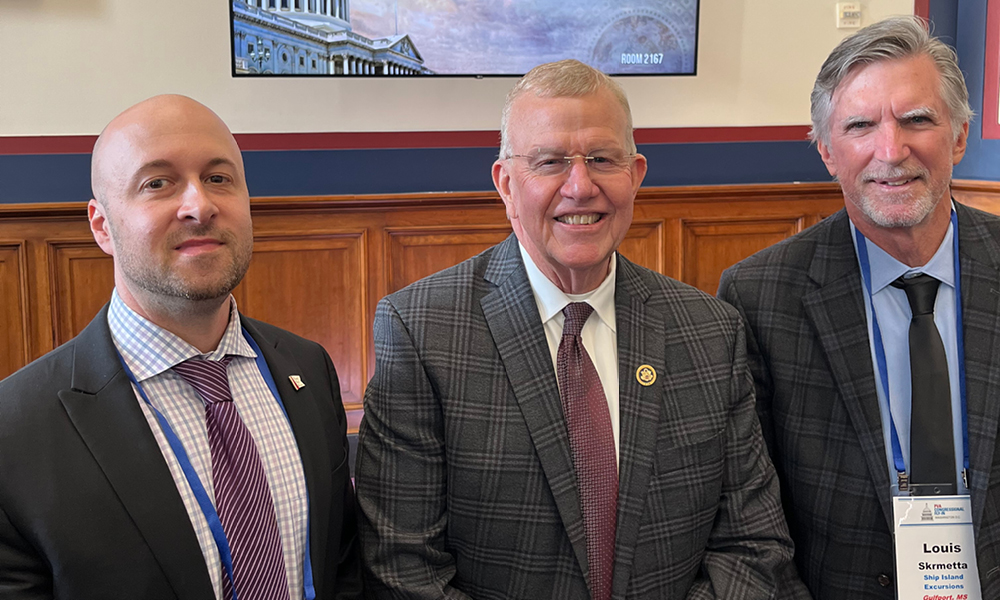
The Passenger Vessel Association (PVA) returned to Washington this spring for our annual Congressional Fly-In, and the urgency was palpable. Our members walked the Halls of Congress with a clear message: The federal government is making choices that will impact America’s maritime infrastructure, and PVA is working hard to influence a positive future for our industry.
We came with four core priorities, and we left with progress on all of them.
Critical Coast Guard Resource Needs
Fund Them Now, and Convene a Hearing
Our most pressing priority going into the fly-in was focused on the state of the U.S. Coast Guard, and specifically the direction it is heading under Force Design 2028. FD2028’s Executive Plan does not use the word “safety” once. It is a strategy document built around military readiness, border enforcement, and drug interdiction. Those are legitimate national priorities, but they cannot come at the expense of the Coast Guard’s marine safety mission which includes vessel inspections, mariner credentialing, waterway enforcement, and the prevention programs that protect passengers every single day. We raised this issue in every one of our meetings on Capitol Hill.
Our most pressing priority going into the fly-in was focused on the state of the U.S. Coast Guard, and specifically the direction it is heading under Force Design 2028.
We are particularly grateful to Congressman Mike Ezell of Mississippi, chairman of the House Subcommittee on Coast Guard and Maritime Transportation, for his time and his candor. Congressman Ezell agrees with us that a focused congressional hearing on Coast Guard priorities is necessary. In 2007, Congressman James Oberstar held this kind of hearing, and the result was the Coast Guard Authorization Act of 2010, which established the marine safety career track that protects passengers to this day. We need that same accountability now. Force Design 2028 is reshaping the Coast Guard in real time, and we look to Congress to ask the hard questions before the Coast Guard’s prevention mission is further degraded.
We also reiterated that Congress’s continued inability to pass Coast Guard funding is unacceptable and not an abstraction. It has had real consequences for operators who rely on timely certificate of inspection renewals and mariners waiting in credentialing backlogs. We are pleased that funding has since been restored but we will remain outspoken about the risks associated with repeating such injurious government shutdowns.
Congressman Thomas Massie of Kentucky once again met with our delegation, and as always, he brought his characteristic depth of knowledge and genuine commitment to waterway safety. He is a true friend of the passenger vessel industry and a tireless advocate for the Ohio River and inland waterways. We are grateful for his partnership during his tenure in the Legislature and regret losing such a good friend in Congress. We hope to see him again on the political stage and engage with him on ways to make our waterways safer.
The FERRIES Act
Investing in Critical Infrastructure
Ferries are not a luxury. They are a necessity for millions of daily commuters, rural residents, and island communities. For many, a ferry is the only practical connection to jobs, medical care, and economic opportunity.
The Federal Enhancement and Revitalization of Reliable Infrastructure for Essential Seaways Act—the FERRIES Act, H.R. 7774—provides the long-term, dedicated federal investment that public ferry systems need to modernize aging fleets, rebuild outdated terminals, and maintain reliable service. It drives demand for U.S.-built vessels and supports the shipyard workforce that constructs them. We asked lawmakers to cosponsor the FERRIES Act, and we made clear that fully funding federal ferry programs through the FTA’s Passenger Ferry Grant Program, the Ferry Service for Rural Communities Program, and the FHWA Ferry Boat Program is not discretionary spending. It is transportation infrastructure.
Small Shipyard Grants
Necessary Support for Small American Shipyards
We thanked Senator Tammy Baldwin of Wisconsin for her steadfast support of the Small Shipyard Grant Program. These grants, administered by MARAD, are not glamorous. They do not make headlines. But they keep the yards that build and repair our vessels competitive. They fund capital improvements, workforce training, and the efficiency upgrades that allow small regional shipyards to survive in an industry that demands ever-increasing technical capability. If we are serious about restoring American maritime dominance, then the Small Shipyard Grant Program is exactly where that work starts.
U.S. Army Corps Defunding
Politics on Our Waterways
The proposed budget cuts to the U.S. Army Corps of Engineers are, frankly, indefensible. A 23 percent reduction to core civil works funding, with over $11 billion in existing projects paused or considered for cancellation are not in the best interests of the public at large. The Chicago Harbor Lock, for example, the second-busiest lock in the country, has seen its funding slashed from $16.6 million to $298,000. That is not enough to keep the lights on, let alone maintain the machinery that moves commercial and passenger vessel traffic.
While on the Hill we heard from members of both political parties that these cuts are unacceptable. No serious person believes that defunding the infrastructure our vessels and others depend on advances American maritime leadership. You cannot declare a commitment to maritime dominance and simultaneously starve the waterways that make commerce and passenger transportation possible.
Our Work Continues in Earnest
PVA’s Congressional Fly-In was, in my opinion, a huge success. We built relationships, reinforced our asks, and laid the groundwork for a future Coast Guard hearing. We will continue pressing Congress to fully fund the Coast Guard, advance the FERRIES Act, support small shipyards, and restore Army Corps funding.
Sincerely,

Andrew Sargis
PVA President, 2026

Andrew Sargis, PVA President 2026