
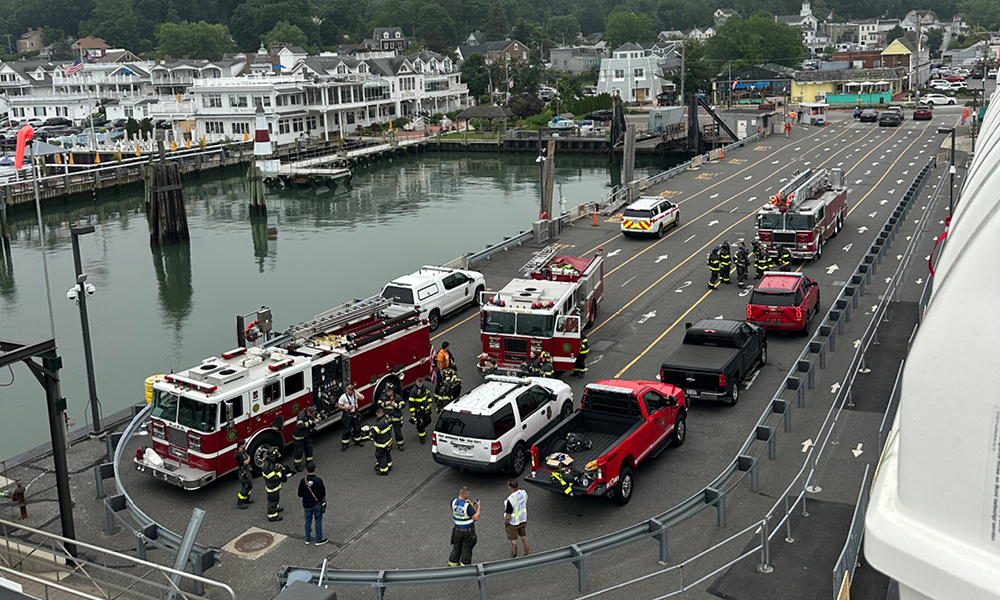
Drills and exercises are key to a maritime crew being prepared to face an emergency. However, when an incident occurs there will likely be other agencies involved in the emergency response. Exercises that include possible first responders such as local fire departments, the U.S. Coast Guard, harbor safety committees, port management groups, or fellow local operators, to name a few, are opportunities to strengthen relationships with these groups, build familiarity with an operator’s vessels and capabilities, establish authority, and practice working together. We reached out to two PVA vessel members who held exercises or drills this summer that involved other agencies to learn more about what they did and the takeaways from their experiences. This article shares the experiences of one team, while another article in this issue looks at the other group’s exercise.
We first spoke with James McGuire and Bruce Topalian from the Bridgeport & Port Jefferson Steamboat Company who collaborated with the Port Jefferson Fire Department for an in-person fire drill in June. As a fully volunteer fire department, the drill was done in the evening aboard the vessel Long Island. Around 6 p.m., the fire chief arrived for a pre-drill briefing while the rest of the fire department arrived around 7 p.m. for the drill. Officers from all Bridgeport & Port Jefferson Steamboat Company’s ferries were also on site.
During this exercise, the firefighters smoked out the entire main cabin of the ferry. “It was pretty realistic,” Topalian said. McGuire described the smoke as so thick that you couldn’t see more than two to three feet in front of you. Smoking out the cabin was done to simulate a search and rescue under such extreme conditions. The fire department had placed both adult- and child-size dummies throughout the cabin. Working in groups, the firefighters had to go into the smoke-filled cabin to find and retrieve the dummies.
“It was pretty realistic,” Topalian said. McGuire described the smoke as so thick that you couldn’t see more than two to three feet in front of you.
Down on the car deck, they simulated a car fire and the firefighters brought on their hoses and discharged them on the deck. Topalian explained that they stressed to the firefighters that because the ferry was out of service, the deck was open—a very different experience than a fully-loaded car deck. When in service, cars are parked approximately 18 to 24 inches apart which would be challenging for the firefighters to maneuver around in full turnout gear.
The proximity of cars when fully loaded lead to another point of discussion. There are fire blankets on the car deck which help to deprive a fire of oxygen in the event of a conventional car fire. The fire department team noted that on a loaded deck, with cars packed closely together, getting the blankets onto a burning car could be challenging. The possibility of an electric vehicle fire was also addressed as that would be a lithium-ion battery-based fire that wouldn’t be as responsive to conventional firefighting methods. There is continued consideration by the company for the different methods existing or in development to fight these fires and it was a point of discussion during and after the drill.
The fire department drilled for about an hour, followed by sessions with the firefighters and vessel officers to discuss such topics as managing electric vehicles and where best to park them on the car deck, considering future training opportunities, and tips and pointers on donning self-contained breathing apparatuses (SCBA). After this, the vessel captain gave the fire department a full tour of the vessel including engineering spaces. They explained the fixed firefighting systems that are in place and how the crew aboard a vessel fights a fire versus how a land-based fire department fights a blaze. The drill was also an opportunity for the Bridgeport & Port Jefferson Steamboat Company to share their fire safety plans with the fire department.
The trip between Port Jefferson in Long Island, N.Y., and Bridgeport, Conn., is about an hour and ten minutes; therefore, the furthest a vessel would be from a dock is 45 minutes. If there would be a fire on board, the hope is that onboard systems such as sprinklers and fire hoses would allow the crew to control the fire long enough for the vessel to reach a dock and for all people to get off the boat safely. Saving lives is the top priority in such a situation and the team hopes they’d be able to disembark passengers and crew through fire corridors and normal means of egress. “We kind of came to an agreement that if we could get the asset to the dock and get the people off, then they [the local fire department] would continue to fight the fire,” McGuire said.
The team also does abandon ship drills on a regular basis. The vessels are equipped with lifeboats, and the stair towers are A60 protected to get people off the ferries safely. These repeated exercises help prepare the crew to respond efficiently and effectively in the event of a casualty when passengers may panic. A calm and quick response by the crew can set the tone for others onboard, hopefully quelling some of the alarm among passengers to help get everyone to safety as fast as possible. In addition, the team has done drills with local law enforcement that involve boardings and practiced responses to active shooter situations.
The drill held this June with the local fire department is something the Bridgeport & Port Jefferson Steamboat Company does fairly regularly. McGuire said they’ve done similar drills about four times over the course of two or three years. Repeating these exercises is essential for everyone involved, especially when considering the turnover rate of an all-volunteer firefighting department or even the change in a vessel’s crew. The drills help the firefighters build or maintain familiarity with the vessels and operation, as well as enable the crew to practice their skills and facing an emergency. It’s also an opportunity for both teams to get to know each other so that the first time they meet is not during a crisis.
McGuire noted that some of the crew are able seaman (ABs) who his team will send to the State University of New York (SUNY) Maritime College for firefighting training. After this summer’s drill, he received an offer from the local fire department for vessel crew to train with the department. He noted that this is one of the benefits of the relationship they established with the fire department training director through this exercise.
Footage taken during the drill showed how much the smoke reduced visibility in the vessel cabin.
These opportunities allow the crew to be more comfortable donning the necessary equipment and knowing what to expect in the event of a fire. In Port Jefferson, the fire department has a building they use for training which they can smoke out and trainees can go through in turnout gear.
In terms of putting together a drill like the one they held in June, Topalian said they start coordinating with the fire department about three to four months in advance. That allows time to find a date on both organizations’ schedules and to work around any logistical concerns that pop up. McGuire and Topalian, their teams, and the fire department all walked away with valuable experience and insight from the drill. They didn’t see anything they would change moving forward and plan to continue hosting these drills to help both companies remain as prepared as possible for an emergency.
Not all drills involve onboard action. Keep reading this issue of Foghorn to learn about the tabletop exercise held by the Hornblower team in San Francisco this summer.