
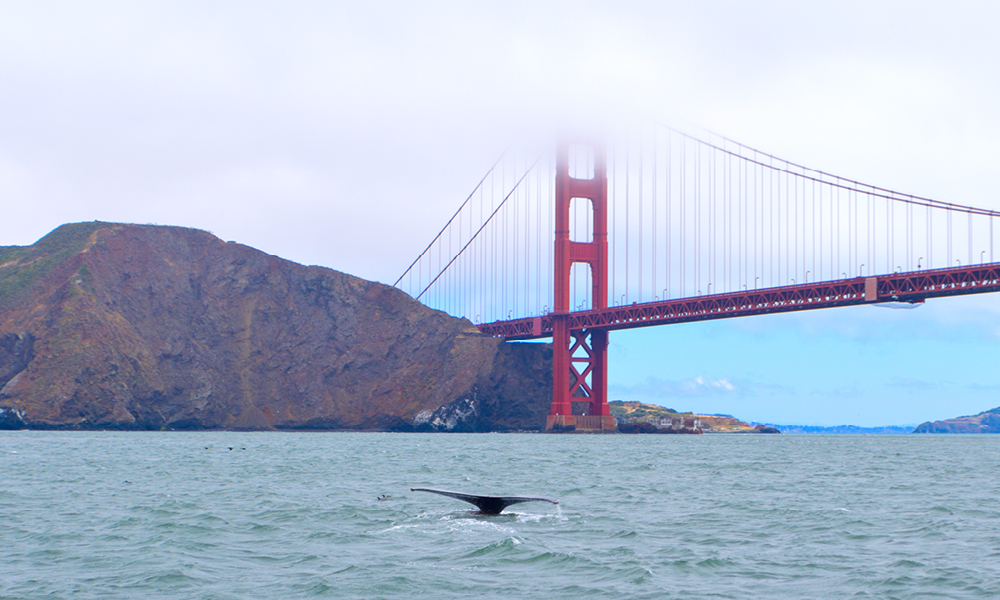
In recent years, the number of whales sighted in the San Francisco Bay has grown significantly, reaching unprecedented numbers. It’s positive news from a conservation perspective and an impressive sight for people traveling on the water. However, the Bay is an extremely busy waterway used by a variety of maritime operations, and whales have been spotted in high-traffic areas such as ferry route lanes and shipping channels. With the rising number of whales there has been increasing concern over the risk of whales being struck by vessels.
Tony Heeter, operations manager at Blue & Gold Fleet in San Francisco, was recognized at the PVA Annual Convention at MariTrends 2026 with the PVA Roger Murphy National Marine Safety Award for his pivotal role in developing initiatives to help mitigate the risk of vessel whale strikes the San Francisco Bay. The Roger Murphy National Marine Safety Award is given annually to a PVA member employee for work done contributing to the overall safety of their organization and the passenger vessel industry. From adjustments of ferry protocol lanes to additional watchstanders to shared communication of whale sightings, the new procedures being adopted throughout the Bay enhance safety for both marine life and maritime operations.
As a vice chair of the Harbor Safety Committee of the San Francisco Bay Region (HSC SF) and part of its Ferry Operations Subcommittee, Heeter has had the opportunity to collaborate with people from throughout the local marine industry including tug operators, members of the San Francisco Bar Pilots, and the Marine Mammal Center. Across these varied groups, participants realized they had common problems that they could band together to address, one being the growing number of whales in the Bay.

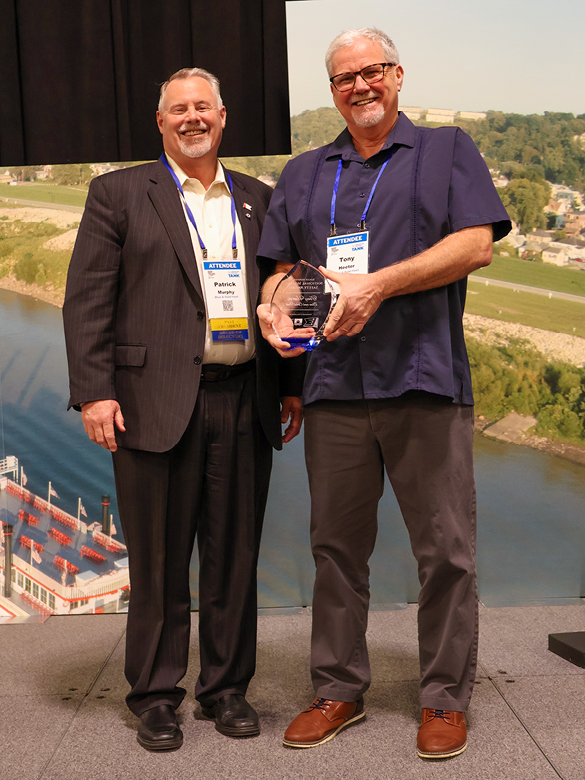
From left; Blue & Gold Fleet President Patrick Murphy and Operations Manager Tony Heeter at the PVA Annual Convention at MariTrends 2026 // Photo: Sarah Ferretti
Outdated ferry protocol lanes were identified as an area where improvements could be made, along with updating the guidelines for them. Ferry routes are usually routine with vessels traveling the same routes on every trip. Protocol lanes are these plotted courses that ferries are expected to use. Seen on a chart as a dotted line, they indicate where other mariners, from vessel captains to kayakers, can expect to see ferries.
The team determined that adding lanes would be a way to divert traffic when whales were present in a particular protocol lane. They tried it out for a while and found that the addition helped their whale strike mitigation plan because it gave them more options. One of the new protocol lanes happened to be in shallow waters where there wasn’t much whale activity which was a plus.
Heeter explained that typically the ferries don’t travel on reciprocal courses and in the San Francisco Bay, they have upbound and downbound lanes. A vessel may travel in one lane on the way to San Francisco and in another lane on the way to Vallejo, for example. Reconsidering this and making lanes bidirectional has been one of the revisions to the protocol lanes, allowing vessels to avoid a lane where whales have been spotted. As Heeter noted, “If you can use it in either direction and there’s no whale over there, why not go over there and use it?”
Communication of whale sightings has been rethought, and sightings are now shared on an open channel. Historically, channel 14 was used only for traffic purposes. The HSC SF worked with vessel traffic service (VTS) and, deeming that identifying whale locations was imperative to navigation, new procedures were adopted allowing operators to use channel 14 to share whale sightings. Operators report the location, direction of travel, and, if they can, the species of whale spotted. The next boat that sees the whale doesn’t report it if it hasn’t changed location. However, if the whale has moved, perhaps from north channel buoy one to north channel buoy three, the captain will call in the new position and details. All operators are informed of the change via channel 14. It’s a streamlined approach so that vessels don’t have to contact VTS with the information and then have VTS relay it to other operators; everyone is listening to the same channel and hears the details in real time.
Communication of whale sightings has been rethought, and sightings are now shared on an open channel.
The key has been to get all operators doing this consistently. It’s been a priority of official messaging and has also been communicated via word of mouth and conversations directly with captains. Having everyone always report sightings and pertinent details allows operators throughout the Bay to plan their routes as safely as possible.
When Heeter came back to the team at Blue & Gold Fleet discussing the tasks the HSC SF was undertaking, the company was receptive to the changes. Patrick Murphy, president of Blue & Gold Fleet, noted that the team jumped in and immediately wanted to know “What can we do to make sure that we’re mitigating any chance or possibility of a strike?”
On the company’s high-speed routes where vessels are traveling over 30 knots, it has always been protocol to have a second watchstander. Blue & Gold Fleet has implemented this same practice on their medium-speed vessels traveling closer to 25-27 knots. Murphy explained that these routes are shorter but often have more traffic patterns within them. These routes also have more stops, and the crew must regularly move between wheelhouse and deck based on responsibilities. Now, there is a second person joining the wheelhouse to stand watch, an extra set of eyes scanning for whales. While the second watchstander has aided efforts to avoid a whale strike, it has the added benefit of offering crew the opportunity for a higher level of training which many are seeking.
The operation understands that there are times when traffic concerns make it impossible to avoid an area with whales. In these cases, vessels are to treat the area as a minimum wake zone and give a wide berth to the creatures.
Part of the company’s policy is to document all their efforts to protect whales. From the second watchstander specifically on the lookout for whales to treating part of a route as a minimum wake zone, all steps taken to avoid a whale strike are logged. The team is focused on consistency, making sure that all possible efforts are made on every trip.
Heeter is also a part of the HSC SF’s Marine Mammal Subcommittee which partnered with the Marine Mammal Center to develop a program called Whale Smart which will offer education and training for commercial operators to help enhance whale safety efforts. The program will be introduced on a learning management system, Heeter explained, and will educate captains on whale strike mitigation, whale species identification, whale behavior, past practices, and more.
All the work being done so far has led to a wealth of data that is helping not only vessel operators but also marine biologist. The operators are recording details such as whale behavior, what the creatures are doing during different tide cycles, which locations they’re in, and their feeding habits based on the tides. Some of this has provided new insights to scientists studying the animals.
The data is also an end goal for the operators. “We feel like if we could get enough data, Heeter said, “we could plan our routes based on whether it was flooding, whether it was slack, whether it was ebbing, and we could use the protocol lanes to our advantage.” To help gather more information one of the next steps will be to begin using WhaleSpotter, an AI and thermal imaging technology that helps to detect whales even in total darkness.
Cameras are mounted to boats and static locations such as islands and bridges and scan the water continuously. Crew, control rooms, and operational dashboards are alerted to the detection of the presence of a whale. According to WhaleSpotter’s site, detections are reviewed within seconds and verified by trained experts around the clock leading to almost zero false positives. The long-term goal is to have that data also appear on the electronic chart systems (ECS) computers as electronic aids to navigation (ATONs) so that vessels would see the location of whales in the area right on their screens.
The long-term goal is to have that data also appear on the electronic chart systems (ECS) computers as electronic aids to navigation (ATONs) so that vessels would see the location of whales in the area right on their screens.
Heeter noted that they hope to get cameras posted on such places at the Bay Bridge or Angel Island. Each location is overseen by a different entity or organization so it will take time and effort to get all stakeholders on board. He said they already have engineers looking at how to mount the cameras on their boats so the opportunity to utilize this technology is growing closer.
While great strides have been made with the new initiatives, Heeter said there is still a lot of work to do. “What we’re doing is not enough, and that’s something that I want to make sure everybody knows,” he said. “We didn’t accomplish enough yet.” The whale season started in the region at the beginning of March and as of the end of April, there were already five dead whales recorded. Last year there were 20 dead whales found in the Bay, which all had hoped was an anomaly. Necropsies are performed, when possible, but it can be hard to know the exact cause of death. One deceased whale was photographed outside the Bay Bridge; it’s believed to have floated into the Bay with the tide and not a death caused by a vessel strike. Some whales may be struck by vessels after dying.
The cause for the surge in whale populations in the area has not yet been determined. People agree that several whales last year appeared to be sick or starving or both. Some have speculated there was a food source shortage in summer when the whales were in Alaska and that they didn’t get enough to eat. Another theory was that an algae bloom further south had sickened some of the whales. “After listening to enough experts,” Heeter said, “the one common theme was nobody really knows. It’s just speculation.” One certainty is that it is early to have five dead whales, he noted. “It’s not a good start [to the season].”
While there is more work to be done, Heeter is hopeful that the technology being adopted will make a significant difference in the endeavors to collect data on whales and create a safer space for both the animals and maritime operations. He brought attention to additional benefits of the initiatives underway which are the strengthened bond and reciprocal efforts among maritime industries that share the San Francisco Bay. Heeter emphasized that numerous people from a myriad of organizations have recognized like interests and put in countless hours of effort into this collaboration thus far.
He’s seen times that the ferries ask for support and the tugs and bar pilots groups help out with ferry protocol lanes and getting initiatives approved. “We get the votes we need. We have the meetings where we go over the text of the guidelines. And now all of a sudden, I’m like, ‘How can I help you guys?’,” Heeter said. “Then that just spreads around. You can see it with the Marine Mammal Subcommittee. Everybody’s on it and everybody’s really into it and passionate about it even though some of these folks, it just doesn’t play much of a role in their lives. It’s just a real reciprocal kind of give and take benefit.”