
Maritime transport is undergoing one of its most significant transitions in decades. From rising environmental expectations to tightening regulation and advances in energy storage, the passenger ferry sector is being reshaped by forces that challenge longstanding assumptions about how vessels should be designed, powered, and operated. What once appeared to be a gradual shift toward cleaner propulsion has become a period of more rapid, structural change.
The global ferry network, long dependent on diesel propulsion and established maintenance ecosystems, is now confronting a new reality defined by factors including fluctuating fuel prices, emerging emissions mandates, and increasing public pressure for quieter and cleaner transport modes. Meanwhile, battery technology, electric drivetrains, and novel vessel architecture is maturing in ways that invite cities and operators to rethink not only vessel procurement but entire service models.
Against this backdrop, many operators and policymakers are no longer debating whether electrification will play a central role in maritime transport, but how quickly it can scale and where it delivers the greatest impact. The evolution is accelerating a transition toward high-efficiency electric hydrofoil vessels as the dominant solution, with diesel and displacement electric vessels playing a role in specific operational contexts.
As technologies evolve, so does the strategic framework within which operators make decisions. Fleet composition, route planning, and infrastructure investment must now consider not only the familiar tradeoffs of speed, range and capacity but also whole lifecycle economics, regulatory alignment and long-term operational resilience.
A Sector At A Turning Tide
Historically, procurement decisions in the ferry sector have followed straightforward economic logic, at a time when diesel was the only option—offering the lowest upfront capital expenditure (CAPEX), requiring little in the way of shoreside infrastructure. Operators subsequently accepted high fuel and maintenance costs as inevitable tradeoffs for reliability and simplicity. Early electrification projects were at this point also not economically strong.
However, the world around these vessels has changed. Fuel price volatility increasingly threatens long-term operating budgets. Regulatory pressure—such as short route zero emissions mandates in parts of the United States and broad decarbonization plans across Europe—is reshaping fleet planning while electric ferries have already set new standards for comfort, performance, and environmental impact, further shifting passenger expectations.
Perhaps the most important driver, however, is the maturity of enabling technologies. Battery prices have steadily declined and efficiency gains in electric drivetrains and vessel architectures have opened pathways once thought impractical. Electric hydrofoil systems have demonstrated the ability to significantly reduce energy consumption at higher speeds, altering the economics of routes traditionally dominated by diesel craft. All this means electric hydrofoiling vessels unlock routes which have historically been unviable or beyond the range of electric displacement vessels. Electric hydrofoiling vessels not only open routes previously unviable for electrification but also improve the economics and performance of existing ones. Through lower total cost of ownership (TCO), reduced charging infrastructure needs and faster service speeds, they offer system-level advantages even where electric displacement vessels are already technically feasible.
As technologies evolve, so does the strategic framework within which operators make decisions. Fleet composition, route planning, and infrastructure investment must now consider not only the familiar tradeoffs of speed, range and capacity but also whole lifecycle economics, regulatory alignment and long-term operational resilience.
Understanding The Capex–Opex Balance
Total cost of ownership in the ferry sector depends on the balance between upfront investment and long-term operation. Over a typical 20-year lifecycle, CAPEX covers the vessel itself including the hull, propulsion system, battery packs (for electric vessels) and any necessary charging infrastructure. Meanwhile, operating expenditure (OPEX) encompasses energy or fuel costs, maintenance, crew requirements, and battery replacements when applicable.
Electric displacement vessels increase CAPEX due to battery systems and charging equipment with electric hydrofoil vessels typically having an additional premium reflecting the complexity of foil structures and control systems. These initial disparities can make procurement teams hesitant. The operating picture, however, is a steep change for operators. Electric vessels significantly reduce fuel costs and eliminate maintenance associated with exhaust systems and complex drivetrains. Hydrofoil vessels further amplify these advantages—using hydrodynamic lift to reduce drag by more than 80 percent. This leads to reduced battery requirements, shorter charging windows and lower long-term infrastructural demands.
Crucially, these efficiency gains are not only realized over the full asset lifecycle. In operating environments characterized by high and volatile fuel prices, particularly where costly biofuels are mandated, electric hydrofoil vessels can achieve payback periods in as little as three years. This enables operators to capture meaningful cost savings early in deployment, rather than waiting for long-term lifecycle benefits to materialize.
The result is that diesel, while still the lowest CAPEX option, is increasingly difficult to justify over a procurement and operational lifecycle, particularly on high-frequency routes where OPEX dominates the cost stack. This dynamic further strengthens the case for high-efficiency electric hydrofoil solutions, where both early-stage and long-term savings are most pronounced.
Comparing Propulsion Technologies Against Routes
When diesel, electric displacement and electric hydrofoil vessels are compared side by side, distinct patterns emerge:


 DieselElectric DisplacementElectric Hydrofoiling
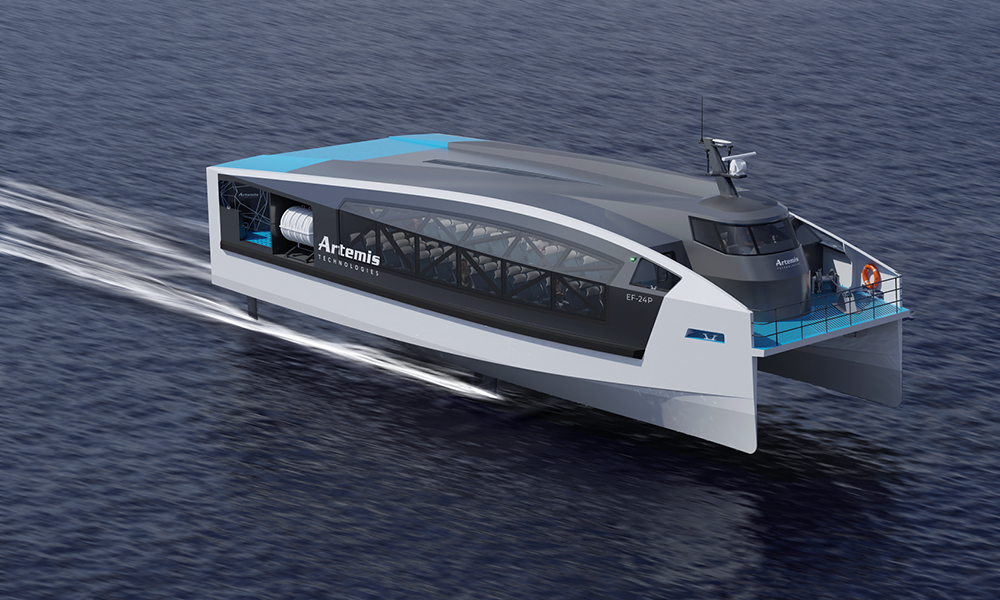
The efficiency gains of hydrofoils are central to their broader economic impact. By lifting the hull clear of the water’s surface, they minimize resistance and energy demand, reshaping everything from battery sizing to shore power requirements. It is within this emerging class that vessels, such as the Artemis EF-24 Passenger, illustrate how efficiency and high-speed operation can be combined without the traditional drawbacks of heavy battery installations or long charging cycles.
Battery Chemistry and Vessel Economics
The choice of battery chemistry remains one of the most important decisions in ferry design. Today’s vessels typically rely on one of three chemistries:
- Cost-efficient and highly durable
- Longer overall lifespan than many chemistries
- Lower energy density than NMC
- Heavier than NMC for the same capacity
- High energy density for reduced vessel weight
- Supports compact, lightweight installations
- More expensive than LFP
- Shorter cycle life than LFP
- Exceptional cycle life and rapid charging capability
- Highly robust and thermally stable
- Very heavy and significantly more costly
- Lowest energy density among the three
- Cost-efficient and highly durable
- Longer overall lifespan than many chemistries
- Lower energy density than NMC
- Heavier than NMC for the same capacity
- High energy density for reduced vessel weight
- Supports compact, lightweight installations
- More expensive than LFP
- Shorter cycle life than LFP
- Exceptional cycle life and rapid charging capability
- Highly robust and thermally stable
- Very heavy and significantly more costly
- Lowest energy density among the three
For a 2,000-kWh installation, the weight difference between NMC and LTO batteries can exceed 25 tons, enough to affect hull design, structural costs and energy consumption. In high-speed or weight-sensitive vessels, lighter chemistries can significantly boost efficiency. By contrast, vessels operating on high-frequency, short-range shuttle routes may favor LTO batteries for their ability to recharge in minutes.
Matching chemistry to operating model is therefore critical, not only for economic reasons but also for regulatory compliance and schedule reliability.
Charging Infrastructure
An Often-Misunderstood Cost Driver
Even as battery prices fall, shoreside charging remains a core factor in determining the practical operational viability of electric ferries. Conventional electric displacement ferries often require high peak charging power to sustain their operating profiles. In ports where electrical capacity is limited, grid upgrades can add substantial cost and delay.
Hydrofoil vessels change this dynamic. Their energy efficiency reduces overall battery size and power demand, enabling significantly lower charging power and shore-side grid capacity. This unlocks flexible infrastructure solutions, including battery energy storage systems (BESS) that buffer the load and reduce the need for major grid reinforcement.
These infrastructure differences can tilt the economic balance in favor of lighter, more efficient architectures, especially in cities where electrical capacity is fragmented or costly to expand.
Lifecycle Cost Comparisons
When modelled over 20 years, the economics become clearer:
This pattern illustrates why more agencies and operators are taking a lifecycle approach rather than relying solely on procurement price. As modern vessels prove their reliability and performance in extended service, these models are becoming more grounded in real world data rather than assumptions.
Matching Technologies To Route Profiles
Route characteristics ultimately determine which propulsion technology offers the best long-term performance.
Short, Frequent Routes (≪ 3 Nm)
Electric displacement vessels often excel, benefiting from regular charging opportunities and lower speed requirements.
Medium Distance Commuter Routes (3-50 Nm)
Here, high-speed operation, tight schedules, and cost sensitivities create conditions where hydrofoil electric vessels offer notable advantages. It is in this space that vessels like the Artemis EF-24 Passenger exemplify how efficiency and reduced charging demands can support demanding commuter patterns.
Long Range Or Low Utilization Routes
Diesel or hybrid vessels remain practical where charging opportunities are limited or where long distances must be covered without stops.
The future fleet will therefore be eclectic-each vessel type matched to the specific constraints and opportunities of its route.
The Rise Of Digital Systems And Operational Intelligence
Advances in propulsion are paralleled by developments in digital safety and control systems. Collision avoidance technologies now integrate radar, optical computer vision, and short-wave infrared imaging to detect small objects-including debris or marine wildlife at long ranges. These sensor fusion systems provide operators with clearer situational awareness which becomes especially important for vessels traveling at high-speed.
Training technologies are also evolving. Highly accurate maritime simulators now acting as ‘digitals twins’ replicate local harbors and cityscapes, enabling operators to train crews well before a vessel enters service.
These tools reflect a broader trend, the modern ferry is becoming not only more energy efficient but also more technologically advanced and operationally sophisticated.
Charting Ahead
The momentum behind cleaner maritime transport continues to accelerate. While diesel retains advantages in simplicity and upfront cost, its long-term economics and environmental footprint make it increasingly misaligned with both emerging regulatory and societal expectations. Conventional electric ferries offer meaningful operational savings where routes permit their limitations. Electric hydrofoil vessels expand what is possible-enabling highspeed, lower impact services once thought impractical for battery-electric systems.
The question for policymakers and operators is no longer whether electric technologies will shape the sector’s future, but how different technologies should be deployed across diverse route networks. As vessels such as the Artemis EF 24 Passenger and others continue entering service, real world data will only deepen our understanding of where these technologies deliver their strongest economic and environmental returns.
What is clear is that the foundational assumptions of ferry economics are being rewritten and the sector’s transformation, once incremental, is now fully underway.
Co-Founder, Artemis Technologies
Tyler is global CMO and leads Artemis Technologies’ North America division based in New York. He played a key role in advancing the company’s transformative Artemis eFoiler® technology, including securing major funding and launching the world’s first fully electric foiling commercial vessel. He has extensive experience in maritime innovation and sustainability initiatives, particularly in accelerating the adoption of zero-emission vessels for offshore operations. Previously, Tyler was commercial director for Artemis Racing’s America’s Cup Challenge.