
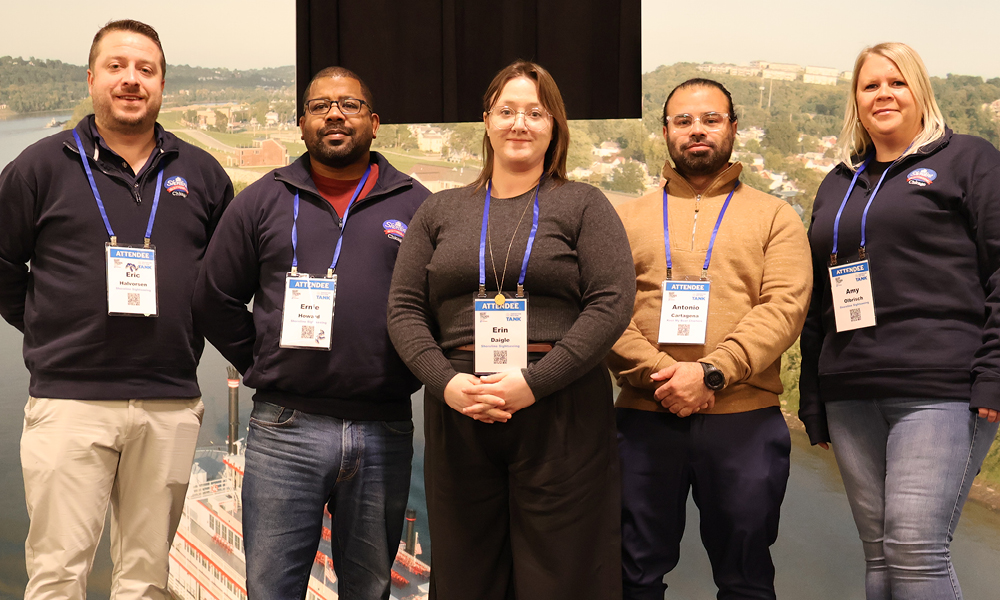
It was around 10:25 a.m. on June 2, 2025, when the Lickety Split had just departed Ogden Slip in Chicago when a call came in on channel 16 that there was a person in the water under Lake Shore Drive Bridge. The vessel was near the location and immediately the crew began scanning the water, looking for the person in distress.
Within a minute, Captain Erin Daigle spotted him. There was little movement in the water, and he was wearing dark clothing, making him hard to see, but she was able to make out a man face down facedown, exhausted, attempting to tread water, but starting to go deeper into the river.
Confirming there was a person in the water, the crew’s training kicked in and they sprang into action. There was no time to pause and assess the situation. As Daigle later said, “We saw that he was struggling to keep his head above water we knew every second could change the outcome of the situation.”
At this year’s PVA Annual Convention at MariTrends 2026, Captain Erin Daigle was honored with the Captain Elizabeth Gedney Passenger Vessel Safety Award which recognizes actions taken by PVA vessel members and their employees in response to an emergency that resulted in a substantial, possibly lifesaving, impact. Daigle led a crew that was able to act quickly and calmly when faced with a crisis and successfully save a man’s life.
On board that day with Daigle were training Captain Antonio Cartagena and Senior Deckhand Wheeler Beathea who were integral to the lifesaving efforts. Daigle ordered the deployment of life-saving equipment as she began maneuvering the water taxi toward the location of the man. She immediately hailed the Chicago Police Marine Unit on channel 16 and stayed in contact with them and the Chicago Fire Department throughout the rescue. Simultaneously, Cartagena advised Beathea of the situation and joined him on deck. Cartagena deployed the life ring and descended the man overboard ladder, successfully reaching the victim with the boat hook. Within just minutes of receiving the initial call, the man was pulled safely onboard the Lickety Split.
Though conscious and still breathing, the man was too weak to communicate. Chicago Police Marine Unit M5 quickly arrived on the scene and by 10:45 a.m. the man was transferred to the police on land, alive and safe thanks to the swift response by Daigle and her crew.
In an emergency, time is of the essence, and crews must be ready to act quickly and efficiently, as the team aboard the Lickety Split did that morning. At Shoreline Sightseeing, the vessel operator, crews frequently do safety and emergency response drills, preparing for just such a situation. As a result, Daigle noted that “the basics are second nature.” It allowed the crew to keep clear minds and stay calm in a crisis.
The maritime industry brings together people from all walks of life. Drills not only prepare crews to handle an emergency but develop to their ability to work together seamlessly and build trust in each other. Daigle takes her relationship with her crew seriously and sees it as her job to know her people and have a thorough understanding of their abilities. As captain, she must be able to lead her team and tailor her instructions to the crew that is on board. “It’s my job to lead from below and raise everyone to the level they need to feel confident and perform well,” Daigle explained. “It’s how we keep our passengers safe.”
As captain, she must be able to lead her team and tailor her instructions to the crew that is on board. “It’s my job to lead from below and raise everyone to the level they need to feel confident and perform well,” Daigle explained. “It’s how we keep our passengers safe.”
She knew her crew on board that day well and was keenly aware that Cartagena and Beathea are experienced boaters. “There is an unspoken trust that has to exist between captain and crew,” Daigle said.
She credits her crew, her managers, and even fellow Chicago boaters with the successful emergency response, noting that it’s because of all these groups that she possesses the skills that “carry me in this industry that I call home.” Daigle continued, “Without my crewmates and their immediate and surgical precision that day, I would be haunted by a very, very different story.”
“Without my crewmates and their immediate and surgical precision that day, I would be haunted by a very, very different story.”
This trust and ability to work so smoothly in unison is even more important on a busy waterway like the Chicago River, which Daigle describes as “a dense and diverse ecosystem.” Captaining a vessel on this river means being acutely tuned into one’s surroundings, all that is happening on the water around you, and how you fit into the puzzle of the daily flow. The river is shared by other passenger vessels including fellow water taxis, architectural boat tours, and sunset cruises. There are large yachts and electric boats. Recreational vessels, kayaks, jet skis, and even hot tub boats share the river as well.
The amount of maritime traffic on a busy summer weekend can seem almost hard to imagine. “The chances of something happening are very high when you have that kind of activity on the water,” Daigle said, “I’ve seen a lot of close calls.”
Being prepared to calmly navigate such crowded waters takes time and practice, and it helps to have someone show you the ropes, offering guidance and advice. Many mariners have mentors throughout their career who can share the wisdom gained from a lifetime on the water to help the upcoming generation build the confidence and knowledge necessary for a successful career in the industry.
Daigle recognized the many mentors she’s had throughout her journey from starting in the industry to today working as captain. She especially thanked her original trainer, describing him as a rock in her early days in the industry. “He taught me how to take the stress of this industry with excitement and tenacity.”
Even the best mentor can’t fully prepare someone for all that they may experience and feel in a crisis. Years of training and drilling meant it was second nature to know what to do that June day, and Daigle was able to act without hesitation, successfully leading the rescue of a man in the water. The training also allowed her to manage her instinct to leave the pilot house and assist hands on.
Daigle knew that once the man was on board, her duty was to keep the boat safely on the makeshift dock and to maintain contact with the emergency services on their way. “We had a line on what appeared to be a concrete bollard,” Daigle explained, “but I would never trust something completely unless I had tested it previously.” She split her throttles, accordingly, resolving to stay close by should anything fail.
She described it as no easy task not to leave the pilot house and help comfort the man in some small way. That “affected me deeply,” she said. “I knew what I needed to do as a captain, but it conflicted with what I wanted to do as a person. It’s not something I anticipated when dealing with a situation like that.”
Her training, the countless drills done as a team, and her years of experience all enable Daigle to recognize but set aside her feelings so that she could stay at her post, focused on the duties that would most effectively assist her crew and the man they rescued. It was proof of the importance of frequent drilling. When faced with a crisis, crews must be able to act as a unit, each performing specific roles, so that they can successfully keep both passengers and fellow crew safe. That ability to act quickly, to acknowledge a conflicting emotion and still stay on task with a focused, clear mind was the result of training to the point that actions were instinct.
While not wanting to instill a sense of paranoia, she noted that it’s not a matter of if, it’s a matter of when a team will have to respond to a crisis. She noted that teams should understand that it could happen at any time. “Know your vessel,” she said. “Know your crew.”
Daigle offered advice to fellow mariners as they prepare for possible emergencies they may face. While not wanting to instill a sense of paranoia, she noted that it’s not a matter of if, it’s a matter of when a team will have to respond to a crisis. She noted that teams should understand that it could happen at any time. “Know your vessel,” she said. “Know your crew.”
While mariners should always be prepared for an emergency, they shouldn’t lose sight of the best parts of a life on the water. Daigle added, “Don’t forget to take a moment to look at the skyline and enjoy your ‘office view.’”